
The perseverance of a man who never gave up and cared for his paralyzed dog has paid off
This kestrel chose to nest near my window
Woman saved a Kangaroo from a forest fire


A cute creature, a raccoon, found a happy family


They hiss, they slither and unfortunately for humans and unsuspecting prey, they bite. Snakes bite about 5.4 million people every year, resulting in between 81,000 and 138,000 deaths, according to the World Health Organization.
Venomous snakes kill their victims with toxic substances produced in a modified salivary gland that the animal then injects into prey using their fangs. Such venom has evolved over millions of years to cause severe reactions in the victim, from immobilization and hemorrhage to tissue death and inflammation, researchers reported in 2019 in the journal Frontiers of Ecology and Evolution.
Here are snakes whose venom not only packs a punch for small prey but that can take out humans. Get ready to run!

About 24 hours after being bitten on the thumb by a juvenile boomslang (also called a South African green tree snake), herpetologist Karl Patterson Schmidt died from internal bleeding from his eyes, lungs, kidneys, heart and brain, researchers reported in 2017 in the journal Biochimica et Biophysica Acta. The snake had been sent to Schmidt at The Field Museum in Chicago for identification. Like others in the field at the time (1890), Schmidt believed that rear-fanged snakes like the boomslang (Dispholidus typus) couldn't produce a venom dose big enough to be fatal to humans. They were wrong.
The boomslang, which can be found throughout Africa but lives primarily in Swaziland, Botswana, Namibia, Mozambique and Zimbabwe, is one of the most venomous of the so-called rear-fanged snakes, according to the University of Michigan Museum of Zoology. Such snakes can fold their fangs back into their mouths when not in use. As in other deadly snakes, this one has hemotoxic venom that causes their victims to bleed out internally and externally, the Museum reported.
With an egg-shaped head, oversized eyes and a bright-green patterned body, the boomslang is quite the looker. When threatened, the snake will inflate its neck to twice its size and expose a brightly colored flap of skin between its scales, according to the South African National Biodiversity Institute. Death from a boomslang bite can be gruesome. As Scientific American describes it: "Victims suffer extensive muscle and brain hemorrhaging, and on top of that, blood will start seeping out of every possible exit, including the gums and nostrils, and even the tiniest of cuts. Blood will also start passing through the body via the victim's stools, urine, saliva, and vomit until they die." Luckily, there is antivenom for the boomslang if a victim can get it in time.

Native to the mountains and grasslands of southeast Australia, the eastern tiger snake (Notechis scutatus) is named for the yellow and black bands on its body, though not all populations sport that pattern, according to the Australian Museum. Its potent venom can cause poisoning in humans in just 15 minutes after a bite and is responsible for at least one death a year on average, the University of Adelaide reported.

Around 58,000 deaths in India are attributed to snake bites every year, and the Russell's viper (Daboia russelii) is responsible for the majority of these mortalities, according to research published March 25, 2021, in the journal PLOS Neglected Tropical Diseases. This species is considered one of the most deadly of the true vipers, researchers reported in 2021 in the journal Toxins.
In Sri Lanka, where this nocturnal viper likes to rest in arable fields, they cause high mortality among farmers during harvest time. The snake's venom can lead to an awful smorgasbord of symptoms: acute kidney failure, severe bleeding and multi-organ damage, researchers reported in the Handbook of Clinical Neurology in 2014. Some components of the venom related to coagulation can also lead to acute strokes, and in rare cases, symptoms similar to Sheehan's syndrome in which the pituitary gland stops producing certain hormones. Victims typically die from renal failure, according to the handbook.

The saw-scaled viper (Echis carinatus) is the smallest member of the "Big Four" in India — along with Russell's viper, the common krait (Bungarus caeruleus) and the Indian cobra (Naja naja) — thought to be responsible for the most bites and related deaths in the country.
Rather than the stereotypical "hissing" sound attributed to snakes, this viper starts "sizzling" by rubbing together special serrated scales when threatened, according to research published in 2013 in the Journal of Venomous Animals and Toxins including Tropical Diseases, according to a journal statement. Once bitten by this viper, a person will have localized swelling and pain in the area, followed by potential hemorrhage. Since the venom messes with a person's ability to clot blood, it can lead to internal bleeding and ultimately acute kidney failure, according to the educational society Understanding Animal Research. Hydration and antivenom (there are nine types of antivenom for this snake) should be administered within hours of the bite for a person to survive, Understanding Animal Research said.
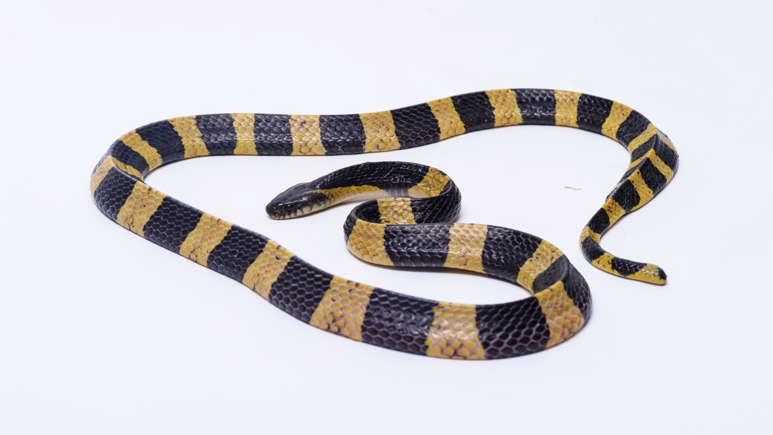
The banded krait (Bungarus fasciatus) is a slow mover during the day and is much more likely to bite after dark. The snake's venom can paralyze muscles and prevent the diaphragm from moving, according to a 2016 study published in the journal PLOS Neglected Tropical Diseases. This stops air from entering the lungs, effectively resulting in suffocation.

The king cobra (Ophiophagus hannah) is the world's longest venomous snake, measuring up to 18 feet (5.4 m), according to the Natural History Museum in London. The snake's impressive eyesight allows it to spot a moving person from nearly 330 feet (100 m) away, according to the Smithsonian Institution. When threatened, a king cobra will use special ribs and muscles in its neck to flare out its "hood" or the skin around its head; these snakes can also lift their heads off the ground about a third of their body length, according to the San Diego Zoo.
Its claim to fame is not so much the potency of its venom, but rather the amount injected into victims: Each bite delivers about 7 milliliters (about 0.24 fluid ounces) of venom, and the snake tends to attack with three or four bites in quick succession, the Fresno Zoo reported. Even a single bite can kill a human in 15 minutes and an adult elephant in just a few hours, Sean Carroll, molecular biologist at the University of Maryland, wrote in The New York Times.
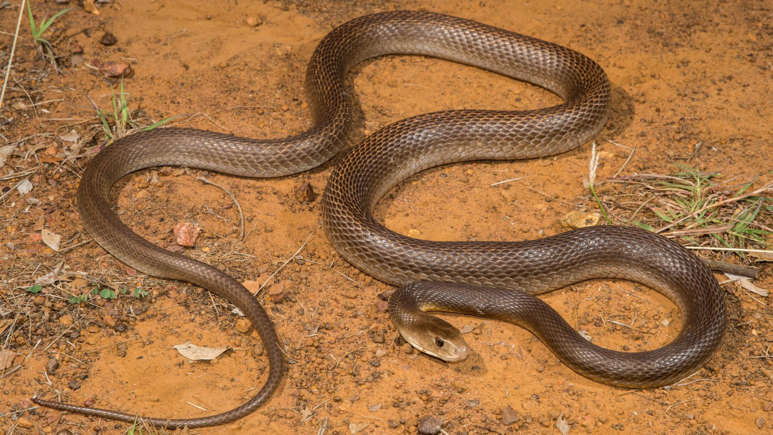
You could be bitten multiple times before becoming aware of the coastal taipan (Oxyuranus scutellatus), thanks to its incredible speed, according to the Australian Museum. When threatened, this snake, which lives in the wet forests of temperate and tropical coastal regions, will lift its whole body off the ground as it jumps fangs-first with extraordinary precision and injects venom into its enemy. Before 1956, when an effective antivenom was produced, this snake's bite was nearly always fatal, according to Australian Geographic.

The inland taipan is the one of the most venomous snakes, according to the International Journal of Neuropharmacology, meaning just a teensy bit of its venom can kill prey (or human victims). They live tucked away in the clay crevices of Queensland and South Australia'a floodplains, often within the pre-dug burrows of other animals. Living in more remote locations than the coastal taipan, the inland taipan rarely comes into contact with humans, the Australian Museum reported. When the taipan does feel threatened, the snake coils its body into a tight S-shape before darting out in one quick bite or multiple bites. A main ingredient of this venom, which sets it apart from other species, is the hyaluronidase enzyme. According to a 2020 issue of Toxins journal (Novel Strategies for the Diagnosis and Treatment of Snakebites), this enzyme increases the absorption rate of the toxins throughout the victim's body.
https://xy2.eu/3iqGd
Plant and animal cells have several differences and similarities. For example, animal cells do not have a cell wall or chloroplasts but plant cells do. Animal cells are mostly round and irregular in shape while plant cells have fixed, rectangular shapes.

Plant and animal cells are both eukaryotic cells, so they have several features in common, such as the presence of a cell membrane, and cell organelles, like the nucleus, mitochondria and endoplasmic reticulum.
A difference between plant cells and animal cells is that most animal cells are round whereas most plant cells are rectangular.Plant cells have a rigid cell wall that surrounds the cell membrane. Animal cells do not have a cell wall. When looking under a microscope, the cell wall is an easy way to distinguish plant cells.
Plants are autotrophs; they produce energy from sunlight through the process of photosynthesis, for which they use cell organelles called chloroplasts. Animal cells do not have chloroplasts. In animal cells, energy is produced from food (glucose) via the process of cellular respiration. Cellular respiration occurs in mitochondria on animal cells, which are structurally somewhat analogous to chloroplasts, and also perform the function of producing energy. However, plant cells also contain mitochondria.
All animal cells have centrioles whereas only some lower plant forms have centrioles in their cells (e.g. the male gametes of charophytes, bryophytes, seedless vascular plants, cycads, and ginkgo).
Animal cells have one or more small vacuoles whereas plant cells have one large central vacuole that can take upto 90% of cell volume. In plant cells, the function of vacuoles is to store water and maintain turgidity of the cell. Vacuoles in animal cells store water, ions and waste.
A lysosome is a membrane-bound spherical vesicle which contains hydrolytic enzymes that can break down many kinds of biomolecules. It is involved in cell processes,like secretion, plasma membrane repair, cell signaling, and energy metabolism. Animal cells have clearly defined lysosomes. The presence of lysosomes in plant cells in under debate. A few studies have reported presence of animal lysosomes in plant vacuoles therefore suggesting plant vacuoles fulfilling the role of the animal lysosomal system.
Plant cells are eukaryotic cells, i.e. cells that have a nucleus which is bound by a membrane. The DNA of the plant cell is enclosed within the nucleus of a cell. Generally, plant cells are rectangular or cube-shaped, and they are larger than animal cells. Do you know that plant cells have a cell membrane with an outer lining called the cell wall? The cell wall is the most prominent feature of the plant cell, thus making it an exceptional eukaryotic cell. The cell wall is made up of cellulose and enzymes. Plants cells also contain several other cellular structures within itself which carry out specific functions, necessary for a plant’s survival. They produce hormones, enzymes, and other metabolic activities in a plant cell.

Every part of the plant cell operates in tandem to ensure the proper functioning of the cell. Here is the role that each component plays.
The Cell Wall
The cell wall surrounds the plant cells like a rigid layer. It consists of 3 layers: the primary cell wall, the secondary cell wall and the middle lamella. Located outside the cell membrane, it provides rigidity, strength, and protection against stress and infection.
The Cell Membrane
The outer boundary of the cell, the cell membrane encloses the cytoplasm and other organelles of a plant cell. It is semi-permeable and allows growth-inducing minerals to pass through while blocking other materials.
Chloroplasts
Chloroplasts have two membranes and have structures that look like stacked coins. It is an elongated organelle that contains the chemical chlorophyll. The chlorophyll is the green pigment that gives colour to the leaves. It absorbs sunlight and helps in the process of photosynthesis by converting light energy into chemical energy.
Animal cells are eukaryotic cells with a nucleus in the centre and specialized organelles. Like plants, the organelles carry out different types of growth-sustaining functions. However, unlike plant cells, animal cells do not have cell walls or chloroplasts.

The cell membrane surrounds the entire cell and is made up of phospholipids. Phospholipids are molecules with a phosphate head that are attached to glycerol and two tails of fatty acid. They form double membranes in water due to hydrophilic properties of the phosphate head and the hydrophobic properties of fatty acids. The cell membrane is selectively permeable and allows molecules of oxygen and carbon dioxide to pass through easily. It obstructs charged molecules mostly but allows some to pass through a special channel in the membrane, thus maintaining homeostasis within the cell.
Animal cells carry out all the bodily processes like production and storage of energy, creation of proteins, replication of the DNA, and transportation of molecules through the body. As discussed earlier, you already know that every cell organelle performs its particular task.Unlike in plants, the human body contains 200 different types of cells. The red blood cells contain haemoglobin, which carries oxygen.

Animal cells are generally smaller than plant cells. Animal cells range from 10 to 30 micrometers in length, while plant cells range from 10 and 100 micrometers in length.
Animal cells come in various sizes and tend to have round or irregular shapes. Plant cells are more similar in size and are typically rectangular or cube shaped.
Animals cells store energy in the form of the complex carbohydrate glycogen. Plant cells store energy as starch.
Of the 20 amino acids needed to produce proteins, only 10 can be produced naturally in animal cells. The other so-called essential amino acids must be acquired through diet. Plants are capable of synthesizing all 20 amino acids.
In animal cells, only stem cells are capable of converting to other cell types. Most plant cell types are capable of differentiation.
Animal cells increase in size by increasing in cell numbers. Plant cells mainly increase cell size by becoming larger. They grow by absorbing more water into the central vacuole.
Animal cells do not have a cell wall but have a cell membrane. Plant cells have a cell wall composed of cellulose as well as a cell membrane.
Animal cells contain these cylindrical structures that organize the assembly of microtubules during cell division. Plant cells do not typically contain centrioles.
Cilia are found in animal cells but not usually in plant cells. Cilia are microtubules that aid in cellular locomotion.
Cytokinesis, the division of the cytoplasm during cell division, occurs in animal cells when a cleavage furrow forms that pinches the cell membrane in half. In plant cell cytokinesis, a cell plate is constructed that divides the cell.
These structures are not found in animal cells but are present in plant cells. Glyoxysomes help to degrade lipids, particularly in germinating seeds, for the production of sugar.
Animal cells possess lysosomes which contain enzymes that digest cellular macromolecules. Plant cells rarely contain lysosomes as the plant vacuole handles molecule degradation.
Animal cells do not have plastids. Plant cells contain plastids such as chloroplasts, which are needed for photosynthesis.
Animal cells do not have plasmodesmata. Plant cells have plasmodesmata, which are pores between plant cell walls that allow molecules and communication signals to pass between individual plant cells.
Animal cells may have many small vacuoles. Plant cells have a large central vacuole that can occupy up to 90% of the cell's volume.
Animal and plant eukaryotic cells are also different from prokaryotic cells like bacteria. Prokaryotes are usually single-celled organisms, while animal and plant cells are generally multicellular. Eukaryotic cells are more complex and larger than prokaryotic cells. Animal and plant cells contain many organelles not found in prokaryotic cells. Prokaryotes have no true nucleus as the DNA is not contained within a membrane, but is coiled up in a region of the cytoplasm called the nucleoid. While animal and plant cells reproduce by mitosis or meiosis, prokaryotes propagate most commonly by binary fission.
Plant and animal cells are not the only types of eukaryotic cells. Protists and fungi are two other types of eukaryotic organisms. Examples of protists include algae, euglena, and amoebas. Examples of fungi include mushrooms, yeasts, and molds.
https://bit.ly/3LQCZv8

Some of them deserve their own horror movies.


