понедельник, 4 мая 2015 г.

10 самых выдающихся изображений в истории науки

Хаббл-Дип-Филд
10 выдающихся изображений в истории науки
«Хаббл-Дип-Филд» — это изображение небольшой области в созвездии Большая Медведица, которое было получено космическим телескопом «Хаббл» за 10 дней — с 18 по 28 декабря 1995 года. Снимаемая область равна примерно 1/28 000 000 площади небесной сферы, а всю картинку собрали из 342 отдельных снимков. После этого изображения глубокого космоса появилось ещё несколько даже более глубоких снимков. Но именно изображение «Хаббл-Дип-Филд» стало первой фотографией, наглядно показавшей реальный масштаб космоса. Все светящиеся объекты на снимке — это целые галактики, которых можно насчитать около 3000 — от ярко выраженных неправильных и спиральных на переднем плане до едва заметных, размером всего в несколько пикселей — на заднем. Этот снимок стал основой для более 400 исследований и статей.
Земля с лунной орбиты
10 выдающихся изображений в истории науки
Майкл Коллинс был членом миссии «Аполлон 11», которая впервые высадилась на Луну. Космический корабль «Аполлон 11» состоял из посадочного модуля «Орёл» и орбитального «Колумбия». Пока Нил Армстронг и Базз Олдрин шагали по Луне, Коллинс оставался в полном одиночестве на лунной орбите в модуле «Колумбия» и так и не коснулся поверхности спутника Земли. Зато он сделал впечатляющие снимки того, как «Орёл» возвращается к «Колумбии» после высадки на Луне. В итоге эта фотография вошла в историю как изображение, на котором есть все люди Земли, и живые, и мёртвые. Даже те, кто ещё не родился, когда была сделана эта фотография, всё равно находятся на этом голубом шаре в виде атомов. Все-все, кроме самого фотографа — Майкла Коллинса.
Фотография Лены Содерберг
10 выдающихся изображений в истории науки
В начале 1970-х инженеры из Университета Южной Калифорнии подыскивали тестовое изображение, которое могло бы стать основой для стандартов JPEG и MPEG. Им надоели изображения с цветными прямоугольниками, и тут Уильям Прэтт предложил использовать фотографию модели Лены Содерберг из ноябрьского номера Playboy за 1972 год, на которой обнажённая девушка в шляпке стоит вполоборота к зеркалу. У снимка был подходящий фурье-спектр, нужное количество деталей и правильный баланс однотонных областей и текстур. Всё это оказалось удачным материалом для тестирования алгоритмов обработки изображений. Исследователям была нужна картинка 512х512 пикселей, так что они отсканировали лишь верхние 5 дюймов разворота журнала. В итоге изображение стало одним из наиболее часто используемых за всю историю информационных технологий и даже чем-то вроде Джоконды диджитал-эпохи. Lenna до сих пор используют в экспериментах с обработкой и сжатием изображений.
Термоядерный реактор в действии
10 выдающихся изображений в истории науки
Joint European Torus (JET, дословный перевод — «Совместный Европейский Тор») — это европейская тороидальная камера; крупнейший в мире действующий экспериментальный термоядерный реактор, который удерживает плазму с помощью магнитного поля. На JET ищут, как провести управляемую термоядерную реакцию, которая в будущем может стать революционным и практически неисчерпаемым источником энергии. В эксперименте 1997 года на реакции дейтерий + тритий был поставлен мировой рекорд мощности управляемого термоядерного синтеза в 16 МВт. На этом изображении видна плазма внутри работающего JET.
Первый рентгеновский снимок
10 выдающихся изображений в истории науки
Вильгельм Рентген сделал свой первый рентгеновский снимок в 1895 году — это был снимок кисти его жены Анны Берты, которая после этого воскликнула, что «увидела свою смерть». Вскоре о сенсационном открытии написали в венской газете Die Presse, а уже в 1896 году на заседании научного общества состоялся официальный доклад. Там же был сделан снимок в Х-лучах кисти Альберта фон Кёлликера, председателя заседания. Он был так восхищён изобретением, что тут же предложил назвать лучи именем Рентгена. Немецкого учёного ждали самые радужные перспективы, но он оказался скромным человеком. Рентген отказался патентовать своё открытие и отвергнул дворянское звание, право на которое давал вручённый орден. Также он отказался возглавить кафедру физики Берлинского университета, журнал «Анналы физики и химии» и Имперский физико-технический институт в Бердине. На вручение Нобелевской премии он не приехал, а денежное вознаграждение лауреата он передал Вюрцбургскому университету.
Бледно-голубая точка
10 выдающихся изображений в истории науки
Pale Blue Dot («бледно-голубая точка») — знаменитая фотография Земли, сделанная зондом «Вояджер-1» с рекордного расстояния. Идея и название снимка принадлежат Карлу Сагану, который также написал одноимённую книгу в 1994 году. «Наша планета — одинокая песчинка, окутанная бесконечной тьмой космоса. Из этой тьмы — из этой бесконечности — нам неоткуда ждать помощи, некому спасти нас от самих себя. Сделать это должны мы сами. Кто-то сказал, что астрономия учит смирению — а я добавлю, что она воспитывает характер. Я считаю, что это изображение нашего крошечного мирка единственно верно показывает, как опасно человеческое тщеславие. Эта фотография подчёркивает, как важно научиться относиться друг к другу с добром и состраданием, как необходимо оберегать и заботиться об этой бледной голубой точке — единственном доме, который у нас есть», — описывается в книги Карла Сагану.
Визуализация Вселенной Millennium
10 выдающихся изображений в истории науки
Трёхмерная модель Вселенной Millennium отображает более 10 млрд частиц и позволяет проследить за распределением материи в кубической области Вселенной с шириной по одной из сторон в 2 млрд световых лет. Суперкомпьютер центра Общества Макса Планка в Гархинге (Германия) рассчитывал визуализацию дольше месяца. Каждая светящаяся точка на изображении — это целая галактика, и насчитать их можно около 20 млн. Также при желании здесь можно найти сверхмассивные чёрные дыры и квазары. Результаты проделанной работы в 2005 году опубликовал журнал Nature. Их до сих пор используют для сравнения с наблюдательными данными. Статья, в которой описаны результаты «Миллениума», получила около 2000 цитирований.
Зарисовки Чарльза Дарвина
10 выдающихся изображений в истории науки
На Галапагосских островах, которые находятся в Тихом океане недалеко от экватора, водится множество вьюрков с клювами разных форм. Общий предок этих птиц случайно попал сюда из Южной Америки, а затем они эволюционировали на островах в полной изоляции. При этом вьюрки с разных островов не могли скрещиваться из-за большого расстояния между ними, поэтому на каждом острове, по сути, живёт отдельный вид. Популяции птиц питались неодинаково, из-за чего их клювы развились по-разному. Одни птицы, которые приспособились есть насекомых, имеют тонкие и острые клювы, а те, что ели орехи, получили крупные и крепкие клювы. Чарльз Дарвин, работая над книгой «Происхождение видов», описал 13 различных вьюрков, когда посещал Галапагосские острова. Именно эти зарисовки птиц сыграли ключевую роль в развитии теории эволюции.
Человечек Пенфилда
10 выдающихся изображений в истории науки
Канадский нейрохирург Уайлер Пенфилд всю свою жизнь посвятил хирургическому лечению эпилепсии. Совместно с электрофизиологом Гербертом Джаспером он проводил операции на открытом головном мозге и использовал электрическую стимуляцию разных отделов. Методика позволяла более точно локализовать эпилептический очаг и разобраться, за что отвечают те или иные структуры мозга. Все данные, собранные за сотни операций, тщательно фиксировали, и к 1950 году хирург смог создать первую подробную функциональную карту коры мозга. Он обобщил основные моторные и сенсорные области коры и точно нанёс области, связанные с речью. В итоге получилась всем знакомая схема — человечек с огромным лицом и большой рукой. Непропорциональность фигуры объясняется тем, что у человека намного больше рецепторов осязания в коже кисти, а участки коры, связанные с рецепторами верхней конечности, намного больше участков, связанных с рецепторами нижней конечности. Эту проекцию можно до сих пор найти во всех учебниках анатомии.
Послание инопланетному разуму
10 выдающихся изображений в истории науки
На американских спутниках «Пионер 10» и «Пионер 11» установили анодированные пластинки из алюминиевого сплава с рисунком Карла Сагана. На рисунке была молекула водорода, фигуры мужчины и женщины на фоне контура аппарата, а также 15 расходящихся из единой точки линий, символизирующих пульсары. По этим линиям можно вычислить звезду, от которой прилетел аппарат (то есть Солнце) и время запуска (благодаря известному периоду пульсаров — рядом с 14 линиями нанесён двоичный код). Также на пластине изображена схема Солнечной системы и траектория аппарата относительно планет. Послание часто критиковали, так как многие символы на картинке внеземной разум может не понять. В частности, инопланетяне вряд ли догадаются, что значат квадратные скобки, в которые помещены двоичные числа, а также что подразумевается под стрелкой и жестом мужчины.

суббота, 2 мая 2015 г.

Технологии, которые вы не заметили

Пять IT-новшеств, которые уже стали частью нашей жизни, но о которых многие почему-то не знали


Прогресс порой так быстро приходит в нашу жизнь, что мы не успеваем заметить, как технологии, которые еще вчера были в фантастических фильмах, становятся реальностью. А про некоторые мы и вовсе еще не знаем. «Газета.Ru» решила помочь далеким от мира IT читателям наверстать упущенное.

Беспроводная зарядка

Смартфоны уже сейчас можно заряжать без проводов. Да, как это делал Никола Тесла. Ну почти. Не знаем, как эта система была построена у великого физика, но в основе современных принципов передачи энергии лежит электромагнитная индукция, знакомая каждому восьмикласснику хотя бы в виде умных слов.
Смартфон Nokia Lumia 920 с площадкой для беспроводной зарядки
Специальная платформа распространяет электромагнитный импульс на небольшое расстояние (на 5–10 см), а плоская медная катушка внутри смартфона получает его.
Происходит немного магии, и из катушки в аккумулятор устройства поступает электричество.
Пока подобная система — удел флагманских смартфонов. Во многом из-за того, что многие о такой возможности не знают и от производителей не требуют. Хотя та же IKEA уже начала выпуск мебели со встроенными индукционными площадками, а в интернете можно заказать наборы для дооборудования своего смартфона подобной функцией.

NFC

NFC сейчас пользуются все. Но никто не знает, что это NFC.
А ведь именно по этой технологии работают, например, турникеты в метро. И банковские карточки, которые нужно просто приложить к терминалу. В смартфонах NFC массово начал появляться в 2013 году и в отличие от беспроводной зарядки устанавливается в большое количество устройств.

Применений у NFC в смартфоне много. Например, можно купить специальную метку (стоит действительно небольших денег), настроить ее и установить на столе. Пришел на работу — провел по метке телефоном — он сам включил нужные настройки, выключил звук, подключился к сети и так далее. С помощью NFC же можно получать информацию о проездных билетах, а при внедрении соответствующей инфраструктуры городскими властями даже пополнять проездной с телефона, просто прислонив карточку. Два смартфона могут синхронизироваться друг с другом по Wi-Fi, если связать их через NFC. Смартфон с NFC-модулем может выступать в качестве замены банковской карты. И так далее.

Miracast

Еще одна давно существующая технология, которая по-прежнему вызывает у большинства «вау-эффект», — это передача изображения на другой экран по Wi-Fi.
Человек, который подключил свой планшет к телевизору без проводов и отправил на него видео с прошлых выходных, как минимум колдун.
Пример работы Miracast. Фотография: androidmagazine.pl
Хотя поддержка технологии Miracast (а именно так она называется) уже давно есть как в телевизорах, подключаемых к сетям Wi-Fi, так и в Android и Windows Phone. Так что проверьте: если у вас есть Android-устройство с версией системы 4.3 и выше, то вполне возможно, что вы тоже можете приобщиться к миру таких колдунов.

Облака

Вы поработали над очень важным документом, который нужно отправить через два часа из дому, сохранили его, выключили компьютер, вышли из офиса и только в подъезде поняли, что флешки с вами нет. Вернуться за документом, очевидно, уже не успеете. А отправлять нужно сейчас.
Интерфейс облачного сервиса Dropbox
Поэтому вы спокойно открываете ту же папку на своем домашнем компьютере, выбираете этот файл и спокойно отправляете его. Потому что работали вы в облаке, которых сейчас огромное количество на любой бюджет и вкус. И фотографии у вас уже давно — прямо во время съемки — отправляются в вашу папку: с устройства их можно удалять, чтобы не забивали память.
И флешки с собой у вас уже года два нет.

Виртуальная реальность

Один из главных атрибутов фантастических фильмов — очки виртуальной реальности. И хотя полноценному устройству нужен компьютер, смартфоны в вычислительных мощностях к ним уже приближаются вплотную. И превратить свой гаджет в полноценные очки виртуальной реальности не так уж и дорого, достаточно найти пару линз, резинок и подходящий кусок картона.
Инструкций по сбору очков из всего этого в интернете огромное количество.
Каркас очков виртуальной реальности Fibrum
Либо можно купить уже готовые решения по абсолютно гуманной цене. Идея состоит в том, что смартфон вставляется в получившуюся конструкцию с линзами, а на его экране отображаются сразу две картинки — для левого и правого глаза. Для этого в магазинах приложений уже имеется огромное количество различных программ. Желательно только, чтобы экран смартфона был Full HD, иначе изображение будет уж слишком зернистым.

пятница, 1 мая 2015 г.

Свершилось! Tesla представила аккумуляторную систему для дома, предприятий и всего мира


Компания Tesla, как и планировалось, представила аккумуляторную систему Tesla Energy, которая может работать и дома, и в офисе, и на предприятии. При этом представлено два разных типа систем: Powerwall и Powerpack. 

Что касается Powerwall, то компания выпустила две модели: 10 кВт ($3500) и 7 кВт ($3000). Размеры системы составляют примерно метр на метр, с толщиной около 18 сантиметров. Powerwall поставляется с поддержкой управления обогревом дома и возможностью управления через Интернет. Заряжаться батареи могут либо от солнечной батареи или ветрогенератора (если таковые установлены), либо от стационарного источника электричества. 

Что может дать установка такой системы дома? Здесь несколько вариантов. Первый — аккумулирование 15 кВт*ч энергии от возобновляемых источников (при их наличии), что позволяет сохранять избыток энергии, а не отдавать его в сеть (за это энергокомпании иногда платят, иногда нет). Кроме того, аккумулятор системы можно заряжать в часы, когда энергия дешевле всего, и использовать эту энергию, когда энергокомпании поставляют её по максимальной цене.


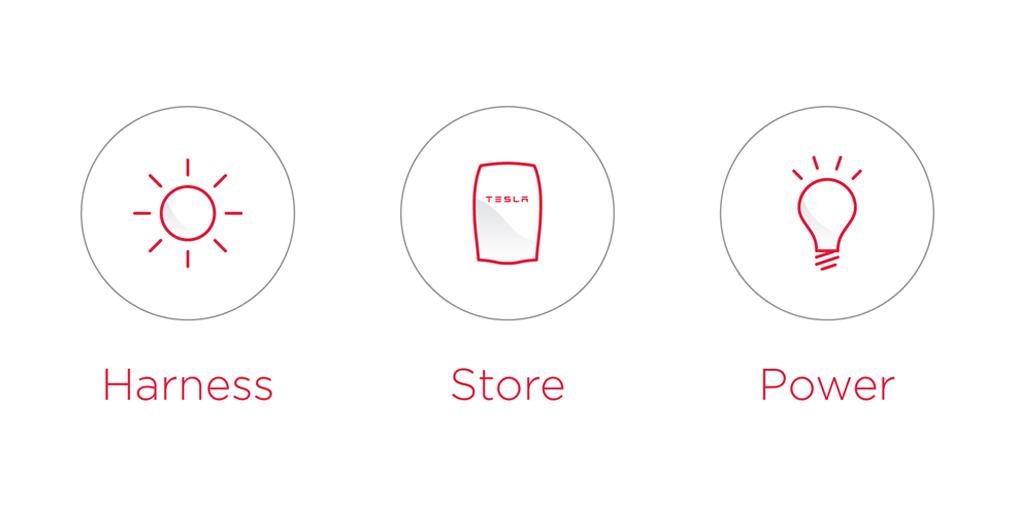
Harness the energy with Powerwall, Tesla’s Home Battery.

Характеристики Powerwall

  • Монтаж: настенный, в здании или на улице;
  • Инверторы: совместимость с большим количеством систем;
  • Энергия: 7 кВт*ч или 10 кВт*ч
  • Среднее: 2 кВт
  • Пик: 3 кВт
  • Напряжение: 350 – 450 В;
  • Ток: номинальный 5 А, пиковое значение 8.5 А;
  • Рабочие температуры: от минус 20 до плюс 43
  • Гарантия: 10 лет
  • Вес: 100 кг
  • Размеры: 1300 мм*860 мм*180 мм


Среднее американское домохозяйство потребляет 30 кВт*ч энергии в сутки, что означает возможность обеспечения нужным количеством энергии в часы пиковых нагрузок и время, когда энергия дороже всего. В системе есть и UPS, благодаря чему электричество в доме или офисе будет даже тогда, когда в местной энергетической инфраструктуре возникают неполадки.


При наличии альтернативных источников энергии свой дом с установленной системой Powerwall можно сделать полностью автономным, независимым от стационарной энергосети.

Powerpack — это «старший брат» Powerwall, система, которая предназначена для предприятий. Эта система может быть масштабирована, и работать даже на крупном предприятии. Так, 100 кВт юниты могут быть объединены в систему от 500 кВт до 10 МВт.

На презентации новых систем Илон Маск упомянул и «Гигафабрику аккумуляторов», которая сможет производить 50 млн кВт*ч батарей в год к 2020 году. По словам Маска, 160 млн Powerpacks хватит для обеспечения энергией всего США, а 2 млрд таких систем хватит для всего мира. 

Система Powerwall проходила различные тесты, работая «в полевых условиях», эту систему уже получили некоторые клиенты. Продажи начинаются летом. Что касается Powerpack, то заказы Tesla начнет принимать позже в этом году, активные же продажи начнутся с вводом в строй «Гигафабрики». 


Стоит напомнить, что ранее Tesla в приглашении разместила фотографию какого-то объекта, и написала, что на встрече будет представлена «недостающая часть». На Geektimes высказывались предположения, что это может быть даже смартфон, или же некое особое стекло для электромобиля Tesla. 

Ранее сообщалось, что цена системы в ~$3000 — это стоимость аренды на 10 лет. Себестоимость Powerwall составляет около $13000, но Tesla приняла решение принимать первоначальный платеж в размере $1500, с последующим разбиванием платежей на 10 лет, с ежемесячной оплатой в размере $15. Часть стоимости системы будет компенсирована энергетическими компаниями, которые поддерживают идею повсеместного внедрения аккумуляторных систем, способных снизить пиковые нагрузки на энергетическую инфраструктуру городов и регионов.

Human gene editing has arrived – here's why it matters


Taking aim at faulty DNA (Image: Power and Syred/Science Photo Library)

It's becoming possible to edit our genes to treat and prevent conditions like HIV and sickle cell disease or, more controversially, create designer babies
GENE editing is here. The first work attempting to edit human embryos grabbed headlines last week. And another study showed how gene editing might prevent children inheriting disease.
It could be decades before it is safe to snip out and replace stretches of DNA to genetically engineer babies – even if it is deemed ethically acceptable. But the approach is already being tested for treating disease in adults and could soon be used to treat a wide range of disorders.
It has been a long time coming. Rudimentary editing methods were first developed some 30 years ago, but only now have techniques been honed to the point that they can be used for treating people. It raises the curtain on a new era of genomic tinkering and genetic medicine.

HIV therapy

In the coming months, four US clinics will recruit people with HIV to a trial of a therapy based on gene editing. HIV wreaks havoc by destroying immune cells called T-cells. It does this by exploiting a receptor, CCR5, on the surface of these cells. Destroy the gene for CCR5 and you can block infection.
Last year, researchers targeted and destroyed this gene in the T-cells of 12 people with HIV using custom-made proteins called zinc finger nucleases. This raised their resistance to the virus. The new trial goes further, knocking out the gene in the stem cells that give rise to T-cells, making it a possible one-shot, lasting treatment. "The goal is a functional cure," says John Zaia, of the City of Hope hospital in Duarte, California.
The trial blazes a path for using the approach to treat other diseases. For example, another trial set to start soon will focus on sickle cell disease, in which the oxygen-carrying haemoglobin molecules in red blood cells are abnormal. The technique would switch on a protein that can be used instead of the haemoglobin.
There could be downsides to this approach though. "Genome editing offers both tremendous promise and significant potential risk," says David Liu of Harvard University. Almost all editing techniques have the potential to modify unintended DNA sequences, he says. "Some of these off-target genome modification events will likely lead to negative biological consequences."
But, if it can be made safe, editing adult stem cells is likely to face fewer ethical hurdles than other applications of gene editing.

Inherited change

Some teams are already exploring the possibility of using gene editing to make heritable changes. Last week, researchers showed that gene editing can weed out mutations in the mitochondria that a female mouse passes on to her offspring.
Mitochondria generate energy in our cells and have their own set of DNA, which differs from that in the cell nucleus. Mutations in mitochondria can cause diseases for which there are no treatments.
Earlier this year, the UK gave the green light to mitochondrial replacement therapy. This involves creating "three-parent babies" with healthy mitochondria donated from a third person preventing such diseases being passed on.
The new approach offers an alternative. It uses a gene-editing technique based on custom-made proteins called TALENs. These proteins can be designed to latch on to the DNA in faulty mitochondria and target them for destruction. Healthy mitochondria remain unharmed.
Most women at risk of passing on faulty mitochondria carry some healthy and some mutated mitochondria, so TALENs could lower the number of mutated mitochondria in their eggs. Harmful effects only kick in once the number of mutated mitochondria crosses a threshold, so this may be enough to prevent disease in their child, and perhaps in future generations too.
Using gene editing in this way isn't without risk, says Robert Lightowlers at Newcastle University, UK. It is unclear whether reducing the number of mitochondria could have a long-term effect, he says. And although the TALENs protein in the study seemed to target only the intended mitochondria, it could be harmful if even a very low amount of it got into the nucleus and altered DNA there.
Juan Carlos Izpisua Belmonte of the Salk Institute for Biological Studies in La Jolla, California, who is part of the team doing the TALENs work, says they plan to begin testing the safety of the technique. "The idea will be to obtain oocytes and discarded embryos from IVF treatments in order to test this technology using human samples."
Taking the research to the next level will be controversial. Last month, a group of scientists called for a moratorium on gene editing research in cells that can form embryos. The plea was made by those working on gene editing with adult cells who are concerned that embryo editing could have unpredictable effects on future generations and stimulate a public outcry.

Uncharted waters

Despite the call for a hiatus, a team in China announced last week that it hadedited DNA in the nucleus of human embryos.

The work involves a technique called CRISPR/Cas9, developed in the last few years. It has the potential to accelerate progress enormously because CRISPR is much faster than conventional gene editing methods (see "How to edit genes").
Despite the hype, there is a long way to go before CRISPR could be used to write genetic disease out of the DNA of future generations. The Chinese study flagged up a number of potential problems. Of the 86 eggs injected, just four were successfully modified. And the resulting embryos were a mosaic of modified and unmodified cells.
This may have been down to the unviable embryos used, which were created when two sperm fertilised the same egg. The team said it used them because ethical concerns preclude the study of gene editing in normal embryos. But that hasn't stopped the work being criticised.
The fuss is because it is the first phase of a more controversial effort to make genomic changes in human embryos intended to be implanted, says George Annas of Boston University. "It is only in the context of this wider project that manipulation of non-viable human embryos moves from curiosity to potentially dangerous – both to the resulting children and their children, and to society at large," says Annas. These concerns over designer babies are less of an issue for mitochondrial gene editing because it is only possible to delete mutant mitochondria, not alter them.
Yuet Kan of the University of California, San Francisco, describes the study as a publicity gimmick. The disease it targeted, beta-thalassaemia, can already be detected by pre-implantation embryonic screening during IVF. "I don't see any need for embryo gene editing," says Kan, who is using CRISPR to treat HIV.
Despite the controversy, at least one group in the US and several more in China are also reportedly working with human embryos. But when it comes to treating disease in the near future, it is the adult methods that hold the most immediate promise. One thing is for sure, the gene-editing genie is well and truly out of the bottle.

How to edit genes


Target a specific sequence
For the TALENs or zinc finger gene editing systems (see main story), this requires designing proteins to bind to the DNA you want to edit.
With CRISPR, only RNA complementary to the target DNA is needed. It takes days to make these, but customised proteins take years.
Cut the target DNA
This is the easy part – enzymes cut your chosen DNA.
Hijack DNA repair systems
Cells repair any strands of cut DNA using the nearest matching DNA as a template. So if you supply the template DNA, you can trick cells into making the changes you want.

Current state of play


Treating disease by modifying genes in adults
Human trials under way
Pros: Could be used to treat all kinds of diseases and disorders
Cons: Could turn cells cancerous if the wrong bit of DNA gets modified
Preventing disease by destroying mutant mitochondria
Testing in human cells about to start
Pros: Could prevent mitochondrial diseases without using a donor
Cons: Effects are heritable, so ethically controversial
Preventing disease by modifying genes in embryos
Testing in human embryos under way
Pros: Could prevent many genetic disorders
Cons: Uncharted ethical and scientific waters; treatments are a long way off
https://bit.ly/3Nd5a85


Inside one pharma's mission to make a transdermal patch for insulin, vaccines, and more

By  | April 30, 2015 


Prometheon Phama's website splash page stakes out a bold claim: "Eliminating needle injections. Improving global health."
The Florida-based pharmaceutical company is, at this point, a fledgling operation, launched and housed in University of Florida's Sid Martin Biotech Incubator since 2012. It has a four-person executive team and four-person Board of Managers. But CEO/CSO Dr. Stephen Hsu and his colleagues aren't letting their firm's small size stymie the breadth of their ambitions.
Prometheon is in the early developmental stages of a transdermal patch technology called Topicon. The company hopes this tech can one day be used as an ultra-convenient vessel for administering large molecule therapies ranging from consumer products like hair growth meds to even drugs like insulin, vaccines, and infectious disease drugs in developing nations. The insulin technology development, in particular, could hold major promise and presents obvious partnering potential with leading diabetes firms, some of which have experimented with alternate methods of administration, including Eli Lilly, Sanofi, or Novo Nordisk.
BioPharma Dive had an extended conversation with Prometheon's Director of Business Development, Devon Grimmé, about what sets the company and its technology apart from competitors, the firm's development timeline and launch hopes, and what issues still need to be addressed in order to ensure that the product succeeds. Note: This interview has been edited for clarity.

The fight for patient convenience and busting the 'Rule of 500'

BioPharma Dive: Who do you see as Prometheon's main competitors? What other patches and technologies out there are you competing against?
Devon Grimmé: The race right now is for patient convenience. Part of that is because patients will prefer more convenient tech. But it's also a function of the patent life cycle of a lot of these companies and their medications, because they need new newer products to keep their portfolios and their sales up. You look at the different pre-fill syringes and they last, 20 days, maybe 40 days. They have Marvel comic book characters on them, whatever—it's all about trying to get to the patient for convenience. You have all these [other alternatives to needle injection] that are starting to come out, you've got Afrezza, the inhaled insulin [from Sanofi and MannKind]. 
We compete with everybody and we could be a great partner for one of the pharma companies that wants to interact with us because, we win on the patient convenience side. There's nothing more simple and less invasive than a completely passive, multi-day transdermal patch. 3M is doing a lot with their micro-needle platform. But the cost to manufacture [those], and the inconsistencies of administration, there's potential for, what my boss kind of came up with a term for, he thinks in the next couple of years we're going to see a rash of "micro-needle infection incidences." 
So really, we compete with anybody that's trying to get a patient to comply with their medication, and we win because we're the least invasive and most convenient. 
BD: From a technical standpoint, what is it that makes this specific tech work that sets it apart from others? We talked about the convenience factor as a marketing tool for reaching patients and doctors. What, in the guts of this, makes it different from other transdermal patches?
Grimmé: The biggest thing is that it's completely passive and that it's for very large molecules—so far, up to [more than] 22,000 daltons [for human growth hormone]. That's the biggest we've tried, but we've never tried anything we couldn't get across the patch.
We were very surprised to learn that the definitive atomic structure of the skin was only published in 2012, and so we're working with that investigator to understand exactly what's happening when our formulation is applied. That investigator said that our formulation perfectly anticipated his structure. We formulated this in 2010, but the structure wasn't published until 2012. It's creating pores and/or loosening up the tight junctions between skin cells and allowing these large molecules to pass through.
Something that's completely unique about it is that all of our ingredients are either Generally Recognized As Safe (GRAS) or are FDA-approved for other indications. The chosen ingredients, by design, were picked to solve the problem of thermosensitivty (having everything solid at room temperature and locked into a stable matrix), and it just so happens that by choosing some of those qualities, these ingredients had secondary and tertiary properties of being very effective chemical penetration enhancers. They'd all been studied as enhancers individually, but never together. And the reason we tried them together was for the thermosensitivity aspect of it, thinking about sub-Saharan Africa and equatorial regions that aren't as cold.
BD: So the large molecule entities used with this tech seem impressive. What is the size of the entities that can be used right now in current patches? 
Grimmé: The patches that are on the market, like the birth control patch, estrogen patch, nicotine patch, pain patch, those are all around 250 daltons or so. And back in 2000, there was an NIH paper written about the "Rule of 500," saying that no molecule greater than 500 daltons could get across skin because the skin was just too effective a barrier.
So, we have shattered the Rule of 500 so far by about 50 times—22,500 daltons—and we don't know the upper limit yet. And once we understand the mechanism of action a bit better, what Dr. Hsu hypothesizes is that it's a bell-shaped curve distribution in the skins. There's different holes of different sizes, so if we can understand that, then we could shift that curve to the right with more holes of greater sizes.

Marketing timelines and getting patients to a 'yes'

BD: You mentioned Afrezza earlier. It's been kind of difficult for these guys to get their prescription numbers up with that product, they haven't exactly been mind boggling. Do you anticipate having some of the same problems? Or do you think that those problems are simply a consequence of the inhaled option not catching on with patients?
Grimmé: I think it's more [the latter]. There's a couple of factors with all of this that are at play there. One is, because [Afrezza's] a rapid-acting mechanism, there's a lot of patient and patient-psychology factors at play.
One thing we discovered when we did our initial Indiegogo campaign, we really started to dialog with the diabetes online community. We were really surprised by how passionate they are, and we found that, essentially, Afrezza is going to be largely a type 1 product. And what we found with type 1s is that, by and large, if they have a regimen that works pretty well for them, they're very hesitant to change it.
I think that's a major factor in it. I think inhaling the insulin and dialing up the dose, in some ways - it's certainly less invasive, but I don't think it's that much more convenient than dialing up on a pump or counting out your vials and getting a dose that way. And I think it's a new learning curve which people are hesitant to do in any scenario, whether that's a consumer product or healthcare product.
BD: Let's talk a little bit about your guys' manufacturing and trial and development timeline. Where are you in that process with various product lines that you're testing? When do you hope to move in to later stage trials and the market?
Grimmé: From a manufacturing standpoint, all of our ingredients and processes are already available at industrial scale. There's already a well-established patch manufacturing industry that we can use as an outsource. In terms of development and testing, we're basically raising or awaiting funding right now to begin large animal studies, pig studies. And that data, which takes about 6 to 9 months to gather, will allow us to apply to the FDA for human trials. Because we're applying under a 505(b)(2) pathway (since insulin is already approved), we anticipate being on the market by 2019. That's what we're shooting for, which is relatively quick as pharma goes.
BD: And which product is furthest along?
Grimmé: Definitely the insulin. There's a caveat to that, which is that our hair growth product may be on the market this year. That, we're getting ready to start human clinical trials on, and should be on the market this year. Insulin is further along in development, we've tested it a little bit more, but hair growth may be a much shorter path to the market.

Dosing questions and global ambitions for public health

BD: What are the safety concerns you're concentrating on most with this technology? Are there safety issues that might arise?
Grimmé: Well, again, the ingredients that we're using are completely passive and are GRAS or FDA-approved for other indications. So the [main] thing that we really have to show in terms of a 505(b) pathway is that our formulation is non-toxic [to the skin]. And it was designed to not be, so our risk there is minimized. The next thing is that we have to show non-inferiority. We're not worried about that because of how effective it is in our initial studies. 
Probably our greatest challenge—and still a small one, because of how efficient it is—is we just have to understand the dosing implications. For example, with the insulin in our initial studies, we were able to deliver the equivalent of 140 units in a week-long cycle—so 140 units a week—we were able to deliver that with the equivalent of just six units of insulin in the patch. So it's very, very efficient, so that's something that we'll have to understand, is the dosing   
BD: Using this technology in really hot places—why is that a concern? What hopes do you have your products in emerging markets and developing nations down the line?
Grimmé: This whole company was started around improving global health. This is really, truly a social enterprise. And it's Dr. Hsu's absolute mission—he left an endowed chair position at almost 50 to start a company. He was really thinking about, how do we get better treatments to people in areas that the main challenge is refrigeration and access to healthcare? What kind of simple products can we give them?


This kind of designed serendipity of discovering that these huge molecules can get across while using a thermosensitive matrix—once we get the funding or partnering for someone to test vaccines, or anti-malarials, imagine a 7-day antimalarial patch or vaccine patch that's totally temperature stable, that doesn't require needles, doesn't have syringes that are having to be disposed of and ruining the environment, or endangering people from needle sticks or reuse. We have a pretty compelling possibility there once that starts taking shape.

NASA's Messenger probe crashes into Mercury

30 April 2015 by Jacob Aron

Messenger's final image (Image: NASA/Johns Hopkins University Applied Physics Laboratory/Carnegie Institution of Washington)
Don't shoot the Messenger – it's already crashed into Mercury. NASA's Messenger space probe, which has been orbiting the planet for more than four years, ran out of fuel and hit the surface at 3:26:02 pm Eastern time (20:26 in the UK) on 30 April.
The spacecraft actually burned the last of its fuel in January, but in April, NASA engineers squeezed out a little extra thrust by venting on-board helium gas, which was used to pressurise the fuel. This gave the craft more time in orbit, with a final boost last Friday.
With nothing left to fight gravity, Messenger (pictured below) crashed into Mercury's surface at over 14,000 kilometres an hour, creating a crater 16 metres across.
(Image: NASA/Johns Hopkins University Applied Physics Laboratory/Carnegie Institution of Washington)
Examining the fresh crater could provide data on how space weathering affects Mercury's heavily pockmarked surface – but this crater is too small to see from Earth, and the Hubble Space Telescope can't look at Mercury because it would have to point at the sun. That means astronomers won't get a good look at it until a joint European and Japanese mission, called BepiColombo, reaches it in 2024.

вторник, 28 апреля 2015 г.

Как на мозг влияет время суток


1. С 6 до 7 утра – «окно», когда лучше всего работает долговременная память, вся полученная информация в этот промежуток усваивается легко.

2. С 8 до 9 включается логическое мышление, это наиболее подходящее время для любой деятельности, связанной - одновременно - с запоминанием и аналитикой.

3. С 9 до 10 утра – оптимальные часы для работы с информацией и статистикой.

4. С 11 до 12 дня эффективность интеллектуальных функций снижается, стало быть, можно переключить внимание на что-нибудь отвлеченное. Например, послушать музыку.

5. С 11 до 14:00 – самое подходящее время для обеда. На эти часы приходится пик, как говорят на Востоке, «огня пищеварения», когда принятая еда переваривается и усваивается наилучшим образом.

6. С 12:00 до 18:00 – идеальное время для активного труда. Труд в более поздние часы вынуждает мозг работать на износ. Первые признаки такого перенапряжения – сложности с засыпанием.

7. С 21:00 до 23:00 происходит наиболее полный отдых ума и нервной системы.

8. С 23:00 до 1 часа ночи, во сне, идет активное восстановление тонкой энергии. В китайской медицине ее именуют «ци», индийские йоги называют ее «праной», современная наука величает нервной и мышечной силой.

9. С 1 до 3 часов, во сне, человек восстанавливает эмоциональную энергию.