George Spagna, chair of the physics department at Randolph-Macon College, explains.
Stars and planets form in the collapse of huge clouds of interstellar gas and dust. The material in these clouds is in constant motion, and the clouds themselves are in motion, orbiting in the aggregate gravity of the galaxy. As a result of this movement, the cloud will most likely have some slight rotation as seen from a point near its center. This rotation can be described as angular momentum, a conserved measure of its motion that cannot change. Conservation of angular momentum explains why an ice skater spins more rapidly as she pulls her arms in. As her arms come closer to her axis of rotation, her speed increases and her angular momentum remains the same. Similarly, her rotation slows when she extends her arms at the conclusion of the spin.
As an interstellar cloud collapses, it fragments into smaller pieces, each collapsing independently and each carrying part of the original angular momentum. The rotating clouds flatten into protostellar disks, out of which individual stars and their planets form. By a mechanism not fully understood, but believed to be associated with the strong magnetic fields associated with a young star, most of the angular momentum is transferred into the remnant accretion disk. Planets form from material in this disk, through accretion of smaller particles.
In our solar system, the giant gas planets (Jupiter, Saturn, Uranus, and Neptune) spin more rapidly on their axes than the inner planets do and possess most of the system's angular momentum. The sun itself rotates slowly, only once a month. The planets all revolve around the sun in the same direction and in virtually the same plane. In addition, they all rotate in the same general direction, with the exceptions of Venus and Uranus. These differences are believed to stem from collisions that occurred late in the planets' formation. (A similar collision is believed to have led to the formation of our moon.)
In the latest Mercedes commercial, one side of this F-Cell car has a camera recording the scenery it passes, while the other side displays that scenery on a field of LEDs, effectively letting you see through the car. Engadget has the video.
Mercedes
A DUST DEVIL ON MARS
Pictured: a Martian dust devil twisting across the Martian Amazonis Planitia region. The 100-foot-wide column of swirling air was captured by the Mars Reconnaissance Orbiter last month as it passed over the northern hemisphere of Mars.
NASA/JPL-Caltech/Univ. of Arizona
BRICKLAYING WOMAN
Channi Anand captured this image of a female bricklayer at a plant on the outskirts of Jammu, Indian, on International Women's Day. Anand is an AP photographer based in and around India. From American Photo.
AP Photo/Channi Anand
FIRESTORM BIRTH
This image, from Hubble's Wide Field Camera 3, shows the chaos of star birth, dust, and collision out in the giant elliptical galaxy Centaurus A. Read more here.
NASA, ESA, and the Hubble Heritage (STScI/AURA)-ESA/Hubble Collaboration
In the most highly publicized Mars discovery of the year, NASA announced that its Mars Reconnaissance Orbiter spacecraft had spotted hydrated salt minerals on the Red Planet (SN: 10/31/15, p. 17). The salty streaks appear in the same places as dark, hillside marks that lengthen and shrink with the Martian seasons. Brine probably oozes from the steep slopes, scientists concluded.
Water on Mars has been reported many times in the past, with each discovery adding fresh nuance to scientists’ picture of the planet. The brine finding is the most detailed evidence yet that water flows on the planet’s surface today. And liquid water — no matter the saltiness — has exciting implications for whether life could exist on Mars.
Chemical evidence for Martian habitability, both past and present, is piling up elsewhere as well. The Curiosity rover, which has been rolling across the planet since 2012, identified a form of nitrogen in Martian rocks that, on Earth, is used to construct biological molecules (SN Online: 3/23/15). Studies of six Martian meteorites, blasted into space by asteroid impacts, reveal that they contain methane, which serves as a food source for microbes on Earth (SN Online: 6/16/15).
Knowing whether there really is life on Mars — or ever was — will have to wait until at least 2020, when NASA plans to launch a rover to collect and store rocks that would eventually be flown back to Earth for analysis. In the meantime, scientists’ freshest views of Mars are from the sky. The MAVEN spacecraft, flying high through the Martian air, has spotted glowing auroras and puzzling dust clouds (SN: 4/18/15, p. 15). And it has measured, more precisely than ever, how powerful solar storms eroded away Mars’ atmosphere (SN: 12/12/15, p. 32), a process that, over billions of years, has caused the Red Planet to lose most of its air.
UNDER THE SEA The underground sea feeding Enceladus’ geysers resembles soda lakes on Earth. NASA's Cassini spacecraft is offering the best evidence yet that Saturn's moon could be a great place to search for extraterrestrial life.
As it winds up its studies of Saturn’s moon Enceladus, NASA’s Cassini spacecraft is offering the best evidence yet that this moon’s buried ocean could be a great place to search for extraterrestrial life.
Cassini, which has orbited Saturn since 2004, has swooped past Enceladus more than 20 times. But only recently have measurements confirmed that, beneath the moon’s icy shell, an underground ocean spans the entire globe (SN: 10/17/15, p. 8). Scientists had suspected for a decade that the moon had a smaller sea, based on geysers spurting near its southern pole, but a widespread ocean means more room for otherworldly microbes to thrive.
Enceladus is freezing — around −200° Celsius at its surface — but heat generated by friction as Saturn’s gravitational pull tugs on the moon probably keeps its buried sea liquid. Where the ocean meets underlying rock, temperatures may even soar to a near-boiling 90° (SN: 4/18/15, p. 10). That’s how hot it has to be in some geothermal springs on Earth for silica in rocks to dissolve, producing a milky-looking fluid. Cassini spotted tiny silica particles in one of Saturn’s rings, probably delivered there from the bottom of Enceladus’ ocean by those gushing geysers, one research team proposes.
On Earth, hot springs are home to bacteria and other creatures; on Enceladus, the chemistry might also be right for life. Using measurements of carbon dioxide and salts from the geysers, scientists calculated that the ocean is probably quite alkaline, similar to household ammonia (SN: 3/21/15, p. 12). Alkaline lakes on Earth, like California’s Mono Lake, are among the most biologically productive aquatic environments on the planet.
Cassini took its deepest dive through the Enceladus geysers on October 28, a close call that will surely yield science for years to come. The swan song, Cassini’s final Enceladus visit, is scheduled for December 19.
Mountains of water ice tower thousands of meters over fields of frozen nitrogen and methane. Glaciers etched with channels hint at heat bubbling up from below. A patchwork of new and old terrains — some laid down in the last 10 million years, some as old as the planet itself — blanket the ground. And what appear to be two ice volcanoes punch through the terrain.
The alien landscapes of Pluto and its moons dazzled scientists and nonscientists alike this year. More than eight decades after its discovery, Pluto became much more than a nondescript point of light. It’s a dynamic, complex world unlike any other orbiting the sun (SN: 12/12/15, p. 10).
“Seeing a new world for the first time, I mean that’s huge,” says Cathy Olkin, a planetary scientist at the Southwest Research Institute in Boulder, Colo., and a deputy project scientist on the New Horizons mission. “It’s amazing to look at this world and realize I’ve been staring at it for years through a telescope and all that detail was there.”
Pluto’s transformation came courtesy of a robotic spacecraft roughly the size of a grand piano (SN: 6/27/15, p. 16). After traveling for nine and a half years across nearly 5 billion kilometers — roughly the distance to the moon and back 6,700 times — New Horizons made its closest approach to Pluto on July 14, just 12,500 kilometers from its surface, close enough to see features the size of New York’s Central Park.
1994 PLUTO IMAGE: A. STERN/SWRI, MARC BUIE/LOWELL OBSERV., NASA, ESA; ALL OTHERS: JHU-APL, NASA, SWRI
As the spacecraft raced toward this remote outpost at roughly 50,000 kilometers per hour, one thing became abundantly clear: People still love Pluto. On flyby day, the world waited anxiously for news from the Johns Hopkins University Applied Physics Laboratory in Laurel, Md., where hundreds of scientists and journalists had gathered for the planet party of the decade (SN Online: 7/15/15). Pictures of Pluto and its largest moon, Charon, soon graced television screens, newspapers and magazines across the globe. The lonely underdog, kicked out of the planet club in 2006, became a celebrity. Planet or not, “Pluto is the star of the solar system,” says mission leader Alan Stern.
As soon as the spacecraft beamed back its first detailed images, it was clear that Pluto had reinvented itself many times during its 4.6-billion-year lifetime (SN: 8/8/15, p. 6). Mountains, ice flows and a region devoid of craters implied that Pluto was geologically alive. The surfaces of some moons in the outer solar system have been reworked as well, but unlike Pluto, those satellites are under the influence of gravity from a host planet. Tiny Pluto, far from any other world, mysteriously changes itself.
So much about Pluto is alien to Earthlings. On a world where a warm day is about −220° Celsius, the bedrock is made of hardened water ice. But there’s also something oddly familiar: Pluto has blue skies. Layers of haze stack on top of one another to build a tenuous atmosphere (SN Online: 10/15/15). The haze scatters sunlight into the nightside, teasing researchers with glimpses of odd landforms faintly illuminated in Pluto’s twilight. Within that atmosphere, ice moves back and forth across hemispheres through the interminable seasons. It appears to snow on Pluto.
Two ice mountains jut out of a textured plain (top), a close-up example of the varied terrain that stretches to Pluto’s horizon (bottom, taken 15 minutes after closest approach).
BOTH: JHU-APL, NASA, SWRI
Even the five moons held a few surprises. Dramatic canyons slash across Charon, whose dark polar cap has no parallel. Styx, Nix, Kerberos and Hydra tumble and spin like a collection of chaotic tops, a dance seen nowhere else in the solar system (SN: 11/28/15, p. 14). And researchers have uncovered all these riches after the spacecraft has transmitted only 20 percent of its data. Complex composition data and images with even more detail have yet to be downloaded. “Who knows what’s going to show up in that 80 percent,” says Mark Showalter, a planetary scientist at the SETI Institute in Mountain View, Calif., who discovered Kerberos and Styx while New Horizons was en route.
Such diversity suggests that even more strangeness awaits in the outer solar system, where the age of discovery is not over. NASA’s Juno spacecraft will arrive at Jupiter in July and plans are under way for a mission to the gas giant’s ice-encrusted moon Europa (SN Online: 6/18/15). In August, NASA tasked engineers at the Jet Propulsion Laboratory in Pasadena, Calif., with figuring out what it would take to return to either Uranus or Neptune, which haven’t been visited since the 1980s.
And then there are the other dwarf planets, such as Sedna and Eris. “It gives me hope for younger people,” says William McKinnon, a planetary scientist at Washington University in St. Louis. “When they want to go out and explore Eris or some other world, they’re going to find even more amazing things.”
New Horizons, meanwhile, is on course for its next stop: 2014 MU69, a 50-kilometer-wide hunk of ice about 1.6 billion kilometers past Pluto (SN Online: 11/5/15). Unlike Pluto, MU69 is probably pristine, an untouched relic from the dawn of the solar system. There, researchers hope to study an example of one of the fundamental building blocks of the planets.
Once MU69 is far behind it, the spacecraft will eventually stop transmitting data. It will leave the confines of the solar system and sail into interstellar space. Long after humans have vanished, New Horizons will continue drifting through the galaxy, a monument to a people who weren’t content to watch those wandering points of light in the sky but reached across billions of kilometers to explore new worlds.
Messenger's final image (Image: NASA/Johns Hopkins University Applied Physics Laboratory/Carnegie Institution of Washington)
Don't shoot the Messenger – it's already crashed into Mercury. NASA's Messenger space probe, which has been orbiting the planet for more than four years, ran out of fuel and hit the surface at 3:26:02 pm Eastern time (20:26 in the UK) on 30 April.
The spacecraft actually burned the last of its fuel in January, but in April, NASA engineers squeezed out a little extra thrust by venting on-board helium gas, which was used to pressurise the fuel. This gave the craft more time in orbit, with a final boost last Friday.
With nothing left to fight gravity, Messenger (pictured below) crashed into Mercury's surface at over 14,000 kilometres an hour, creating a crater 16 metres across.
(Image: NASA/Johns Hopkins University Applied Physics Laboratory/Carnegie Institution of Washington)
Examining the fresh crater could provide data on how space weathering affects Mercury's heavily pockmarked surface – but this crater is too small to see from Earth, and the Hubble Space Telescope can't look at Mercury because it would have to point at the sun. That means astronomers won't get a good look at it until a joint European and Japanese mission, called BepiColombo, reaches it in 2024.
Astronomers announced today that they have found eight new planets in the "Goldilocks" zone of their stars, orbiting at a distance where liquid water can exist on the planet's surface. This doubles the number of small planets (less than twice the diameter of Earth) believed to be in the habitable zone of their parent stars. Among these eight, the team identified two that are the most similar to Earth of any known exoplanets to date.
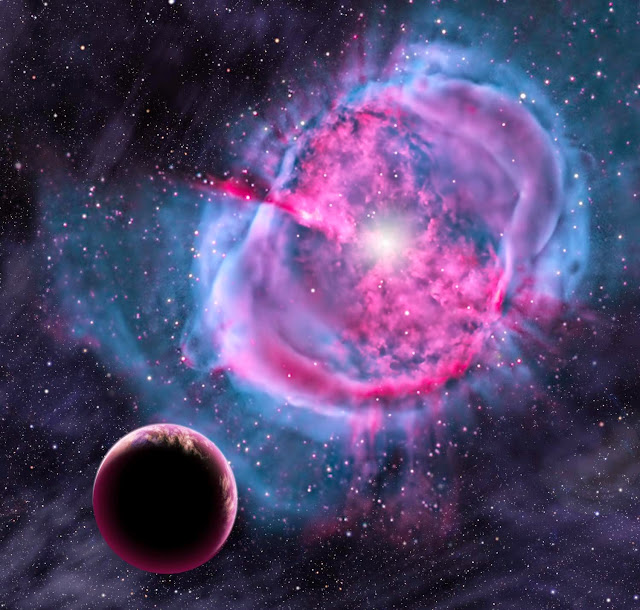
This artist's conception
depicts an Earth-like planet orbiting an evolved star that has formed a
stunning [Credit: David A. Aguilar/CfA]
"Most
of these planets have a good chance of being rocky, like Earth," says lead
author Guillermo Torres of the Harvard-Smithsonian Center for Astrophysics
(CfA).
The two
most Earth-like planets of the group are Kepler-438b and Kepler-442b. Both orbit red dwarf stars that are
smaller and cooler than our Sun. Kepler-438b circles its star every 35 days,
while Kepler-442b completes one orbit every 112 days.
With a
diameter just 12 percent bigger than Earth, Kepler-438b has a 70-percent chance
of being rocky, according to the team's calculations. Kepler-442b is about one-third larger than Earth,
but still has a 60-percent chance of being rocky.
To be in
the habitable zone, an exoplanet must receive about as much sunlight as Earth. Too much, and any water would boil away as
steam. Too little, and water will freeze solid. "For our calculations we
chose to adopt the broadest possible limits that can plausibly lead to suitable
conditions for life," says Torres. Kepler-438b receives about 40 percent
more light than Earth. (In comparison, Venus gets twice as much solar radiation
as Earth.) As a result, the team calculates it has a 70 percent likelihood of
being in the habitable zone of its star. Kepler-442b get about two-thirds as
much light as Earth. The scientists give it a 97 percent chance of being in the
habitable zone.
"We don't know for sure whether any of
the planets in our sample are truly habitable," explains second author
David Kipping of the CfA. "All
we can say is that they're promising candidates." Prior to this, the two
most Earth-like planets known were Kepler-186f, which is 1.1 times the size of
Earth and receives 32 percent as much light, and Kepler-62f, which is 1.4 times
the size of Earth and gets 41 percent as much light.
The team studied planetary candidates first identified by NASA's Kepler mission. All of the planets were too small to confirm by measuring their masses. Instead, the team validated them by using a computer program called BLENDER to determine that they are statistically likely to be planets. BLENDER was developed by Torres and colleague Francois Fressin, and runs on the Pleaides supercomputer at NASA Ames. This is the same method that has been used previously to validate some of Kepler's most iconic finds, including the first two Earth-size planets around a Sun-like star and the first exoplanet smaller than Mercury. After the BLENDER analysis, the team spent another year gathering follow-up observations in the form of high-resolution spectroscopy, adaptive optics imaging, and speckle interferometry to thoroughly characterize the systems. Those follow-up observations also revealed that four of the newly validated planets are in multiple-star systems. However, the companion stars are distant and don't significantly influence the planets. As with many Kepler discoveries, the newly found planets are distant enough to make additional observations challenging. Kepler-438b is located 470 light-years from Earth while the more distant Kepler-442b is 1,100 light-years away. These findings were announced today at a meeting of the American Astronomical Society.