Launched in 1977, Voyager 1 is now over 15.4 billion miles (24.8 billion km) from Earth. It left the solar system in 2012, becoming the first human-made object to enter interstellar space. But when viewed on the scale of our galaxy, its path looks like a scratch on the surface of something unimaginably vast.
Traveling at about 38,000 mph (17 km/s), Voyager 1 will take nearly 40,000 years just to pass near another star – Gliese 445, 17.6 light-years away. To complete a single orbit around the Milky Way’s center? It would take over 400 million years.
The Milky Way is about 100,000 light-years wide. Even after one million years, Voyager 1 will still be drifting through the Orion Spur – a small arm between Sagittarius and Perseus – barely having moved across the galactic map.
And yet, it’s still sending signals home.
Its power source – a radioisotope thermoelectric generator – keeps its instruments alive, though NASA expects contact to fade sometime between 2025 and 2030. When it does, Voyager 1 will continue its silent voyage alone.
Onboard is the Golden Record – a time capsule filled with Earth’s languages, music, and greetings. It’s a message to the cosmos from a small blue planet, carried by a spacecraft that, even after a million years, will still be lingering near home.
It’s a humbling reminder: we’ve made it far. But we've got a long way to go.
Captured by NASA’s Cassini spacecraft during its Grand Finale dive in 2017, this is the closest we’ve ever seen Saturn. Just 1,200 kilometers (745 miles) above the cloud tops, Cassini dove between the planet and its rings — a region no spacecraft had dared to explore before.
Look closely and you can see the stunning detail of Saturn’s upper atmosphere — the swirling clouds, the subtle hues, the raw power of a gas giant in our own solar system.
This image isn't just a photo — it’s a farewell. Cassini took this shot before diving into Saturn’s atmosphere and ending its mission, burning up to protect Saturn’s moons from contamination.
A final kiss from a robot explorer to the ringed giant it loved.
Most of us sweat a lot when we work out. And while many workout clothes today have been specifically designed to help sweat evaporate more easily, none of them had done so using bacteria. Until now. A group of researchers at MIT developed a prototype that uses B. subtilis—when it comes in contact with sweat, it absorbs the moisture and relaxes, allowing the clothing to relax, too. The researchers say this new tech is just a stepping stone on the way to developing a shirt that can also make your sweat smell good.
No dye needed
Joshua Stevens/NASA
2 of 5
This lake isn't great for swimming. Located in Northern Tanzania, Lake Natron is one of the most inhospitable places in the world. Because its located just beneath a volcano, the lake receives a steady supply of molten lava, the contents of which turns the lake its fiery red color. While most living creatures wouldn't survive one second in that water, some salt-loving extremist bacteria bask in the briny depths. The image here of the lake was taken this past March via the The Operational Land Imager (OLI) on Landsat 8.
Lift off
Rocket Lab
3 of 5
New Zealand's first commercial rocket took to the skies this week, following three scrubbed attempts. The Electron Rocket, which belongs to New Zealand's Rocket Lab company, stands only at 55 feet tall. It could become an inexpensive way to place small satellite systems into space.
New images from NASA's Juno mission, which launched in 2011 and went into orbit around Jupiter in August of last year, show the gassy planet's turbulent atmosphere. This one, which NASA just released this past week, shows that both of Jupiter's poles contain swirling storms the size of Earth.
Shape shifters
Michael Indresano Production
5 of 5
Can't decide on what shape of pasta you want? Perhaps one day you might not have to. A group of researchers from MIT used the adaptive absorption of gelatin to develop a pasta sits flat in its packaging, but then forms into 3D shapes when it comes into contact with water. With some more research, they think consumers could even design their own shapes at home. Here's a cool video of the process in action.
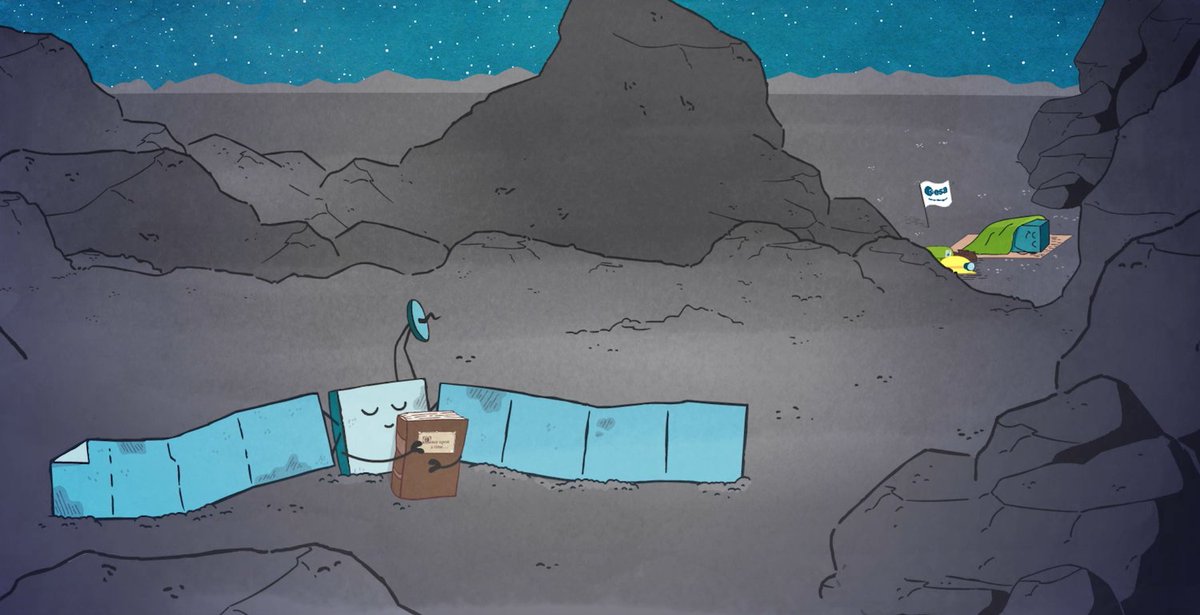
Rest in peace, Rosetta. The comet-chasing European spacecraft descended to its death this morning in a controlled crash, after a two-year mission to explore a duck-shaped comet as it approached the sun.
Despite the Philae lander's botched landing in 2014, the Rosetta mission's orbiter went on to accomplish great things, and this morning it gave the mission the soft landing originally intended for Philae. The orbiter touched down at a nice and easy pace of about two miles per hour.
European Space Agency scientists knew they would have to pull the plug sometime. Rosetta's job was to monitor changes in Comet 67P/Churyumov-Gerasimenko as its orbit brought it closer to the sun, heating it up and causing gas and dust to poof off. Now the comet's path has brought it away from the sun and it's getting colder and darker. Rosetta's solar panels were no longer getting sufficient sunlight to keep the spacecraft warm and powered-up enough to function. Communications were also becoming more difficult.
Battered from comet dust and radiation, and running low on the fuel that would keep it in orbit, Rosetta's death dive provided a treasure trove of new data about the comet. The slow-motion plummet allowed Rosetta to sample gas and dust closer to the surface than ever before, and onboard cameras snapped pictures of the "goose bumps" lining the pits in the region of Rosetta's final resting place. These 3-foot-wide lumps are believed to be the remains of the gunk that clumped together to form the comet back in the early days of the solar system.
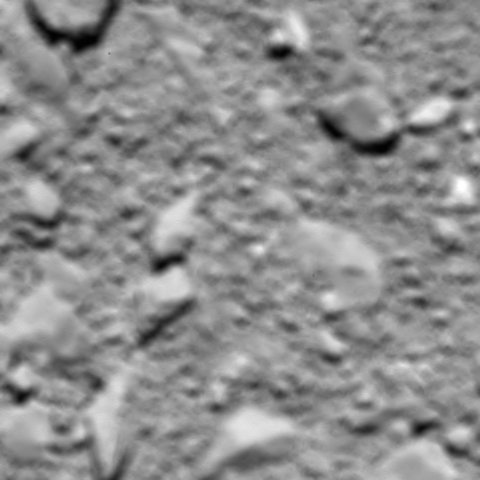
Rosetta crash-landed in a 430-foot-wide pit known as Deir el-Medina. It sent back its last photograph from a distance of about 167 feet.
To date, scientists have only sorted through about five percent of all the data from the ROSINA instrument, which measured the composition of the comet's surroundings. So although the mission is over, we'll still be learning about Rosetta's findings for months to come.
The European Space Agency's (ESA's) Rosetta spacecraft is nearing the end of its life. Launched in 2004, the spacecraft was sent to study comet Comet 67P/Churyumov-Gerasimenko. It finally got to its destination in 2014 exploring the rubber duck-shaped comet, along with its trusted companion and unlucky lander Philae, which had a rough landing on the comet's surface.
It's been a long trip, that has given scientists a great deal of information but the ride is set to come to an end on September 30th, at approximately 6:30 Eastern time (10:30 UTC), when Rosetta will crash into the comet it has been pursuing for so long. The ESA announced today that Rosetta's final resting place would be the Ma'at region, an area of activity on the comet's shrinking surface.
Researchers hope to gather more data about the region from Rosetta as it goes down.
NASA's Juno spacecraft is about to make history when it flies by Jupiter on July 4th, giving scientists our best look yet at the eerie King of the Planets. But even before then, it's returning some fascinating new information from the Jovian system. Take a listen to these sounds recorded by Juno as it entered Jupiter's magnetic field on June 24, and tell me it doesn't send shivers down your spine (in the best way).
The view from Juno as it zooms toward Jupiter's north pole. This was the last thing Juno saw before it powered down its instruments in preparation for entering Jupiter's orbit at 11:38pm Eastern on July 4.
WE'RE ON THE SCENE FOR THE JUNO SPACECRAFT'S ARRIVAL AT JUPITER TONIGHT
PASADENA, Calif. — Coming to you from the center of the universe.
After a 9am Pacific time press briefing, the Juno team updated the world with what we can expect from this evening's exciting arrival of Juno at Jupiter. The team is simultaneously thrilled and nervous while they await news of the outcome.
Juno is due to enter orbit around Jupiter at approximately 8:38pm PST (that's 11:38pm EST), after which there should be a sigh of relief heard around the world.
Juno is on a mission to better understand the biggest planet in our solar system. What makes this orbit insertion so dangerous is not only the speed that it’s traveling but the intense radiation environment at Jupiter. The team has more than prepared for the spacecraft to get blasted with harmful particles, but because we’ve never flown this close to Jupiter, they have no idea what could go wrong in this unfamiliar environment.
JPL released the last image taken from Juno five days ago after all of it’s nine instruments were turned off in preparation for orbit insertion. The image shows Jupiter and its four main moons looking tiny as Juno swoops in at 165,000 miles per hour.
The newsroom is slowly filling up with news media from around the world, as everyone comes together on this 4th of July to document this important scientific mission. Keep up with us here and on Twitter as we share fun photos and information live from mission control in Pasadena, California. And tune in later for the livestream of Juno's arrival at Jupiter!
Lasers are now advanced enough to help launch interstellar space probes, researchers say.
Scientists calculate that a gram-sized laser-propelled space probe could reach more than 25 percent of the speed of light and arrive at the nearest star in about 20 years.
The Voyager 1 spacecraft launched in 1977 is finally leaving the solar system after 37 years of flight at a speed of roughly 38,000 miles per hour or less than 0.006 percent the speed of light. This suggests that with conventional propulsion technology, humanity will never reach even the nearest stars, says experimental cosmologist Philip Lubin at the University of California, Santa Barbara.
Lubin and his colleagues suggest that, instead, lasers could accelerate small probes to relativistic — that is, near-light — speeds, reaching nearby stars in a human lifetime. "No other current technology offers a realistic path forward to relativistic flight at the moment," Lubin says.
The problem with all thrusters that current spacecraft use for propulsion is that the propellant they carry with them and use for thrust has mass. Interstellar spacecraft require a lot of propellant, which makes them heavy, which requires more propellant, making them heavier, and so on.
Photon drives instead involve equipping spacecraft with mirrors and depending on distant light sources for propulsion. Solar sails rely on light from the sun, while laser sails count on powerful lasers.
Lubin acknowledges that photon drives are nothing new — in a letter to Galileo Galilei in 1610, Johannes Kepler wrote, "Given ships or sails adapted to the breezes of heaven, there will be those who will not shrink from even that vast expanse." What is new, Lubin says, is that recent, poorly appreciated breakthroughs in laser technology suggest they can now accelerate spacecraft to relativistic speeds.
Breakthroughs in laser technology suggest they can now accelerate spacecraft to relativistic speeds.
The advance that Lubin's approach depends on involves laser arrays. Instead of building one extremely powerful laser — a technologically challenging feat — researchers now can build phased arrays that are made of a large number of relatively modest laser amplifiers that can sync up to act like a single powerful laser. This strategy also eliminates the need for a single giant lens, replacing it with a phased array of smaller optics.
The researchers envision a phased array of currently existing kilowatt-scaleytterbium laser amplifiers that can scale up gradually, adding lasers over time. For instance, a current 1- to 3-kilowatt ytterbium laser amplifier is about the size of a textbook and weighs roughly 5 kilograms.
Eventually, the scientists calculate that a 50- to 70-gigawatt array that is 10 kilometers by 10 kilometers large in Earth orbit could propel a gram-sized wafer-like spacecraft with a 1-meter-wide sail to more than 25 percent of the speed of light after about 10 minutes of illumination, which could reach Mars in 30 minutes and Alpha Centauri in about 20 years. The researchers suggest this array could launch roughly 40,000 relativistic wafer-sized probes per year — each "wafersat" would be a complete miniature spacecraft, carrying cameras, communications, power and other systems.
The same array could propel a 100-ton spacecraft — about the mass of a fully loaded space shuttle, sans rockets — with a 8.5-kilometer-wide sail to about 0.2 percent of the speed of light after about 15 years of illumination. However, it would take about 2,200 years to reach Alpha Centauri at those speeds. Lubin suggests a larger array would make more sense for a human interstellar trip in the distant future, "but I personally do not see this as a priority until many robotic probes have established a need to do so."
A major problem with this strategy is braking — the researchers currently have no way to slow down these laser-driven spacecraft enough for them to enter into orbit around the distant planets that they are dispatched to. The first missions that accelerate to relativistic speeds may have to simply fly by targets and beam back their data via lasers, Lubin notes.
Lubin notes there are many additional uses for such a laser array other than space exploration. For example, it could deflect asteroids away from Earth, or blast debris out of orbit to prevent it from threatening spacecraft, astronauts and satellites.
They are currently testing to show that small lasers can stop asteroids from spinning.
The researchers stress that they are not proposing to immediately build the largest system. They are currently testing small lasers on asteroid-like rock samples to show that such systems can stop asteroids from spinning, work that could help one day wrangle asteroids for exploration.
If lasers are the only practical route for interstellar travel, Lubin and his colleagues suggest that alien civilization may currently use lasers to help explore the cosmos. They suggest that SETI projects should look for telltale signs of such technology.
Lubin presented his latest work in a talk on January 25 at Harvard.
UNDER THE SEA The underground sea feeding Enceladus’ geysers resembles soda lakes on Earth. NASA's Cassini spacecraft is offering the best evidence yet that Saturn's moon could be a great place to search for extraterrestrial life.
As it winds up its studies of Saturn’s moon Enceladus, NASA’s Cassini spacecraft is offering the best evidence yet that this moon’s buried ocean could be a great place to search for extraterrestrial life.
Cassini, which has orbited Saturn since 2004, has swooped past Enceladus more than 20 times. But only recently have measurements confirmed that, beneath the moon’s icy shell, an underground ocean spans the entire globe (SN: 10/17/15, p. 8). Scientists had suspected for a decade that the moon had a smaller sea, based on geysers spurting near its southern pole, but a widespread ocean means more room for otherworldly microbes to thrive.
Enceladus is freezing — around −200° Celsius at its surface — but heat generated by friction as Saturn’s gravitational pull tugs on the moon probably keeps its buried sea liquid. Where the ocean meets underlying rock, temperatures may even soar to a near-boiling 90° (SN: 4/18/15, p. 10). That’s how hot it has to be in some geothermal springs on Earth for silica in rocks to dissolve, producing a milky-looking fluid. Cassini spotted tiny silica particles in one of Saturn’s rings, probably delivered there from the bottom of Enceladus’ ocean by those gushing geysers, one research team proposes.
On Earth, hot springs are home to bacteria and other creatures; on Enceladus, the chemistry might also be right for life. Using measurements of carbon dioxide and salts from the geysers, scientists calculated that the ocean is probably quite alkaline, similar to household ammonia (SN: 3/21/15, p. 12). Alkaline lakes on Earth, like California’s Mono Lake, are among the most biologically productive aquatic environments on the planet.
Cassini took its deepest dive through the Enceladus geysers on October 28, a close call that will surely yield science for years to come. The swan song, Cassini’s final Enceladus visit, is scheduled for December 19.
Mountains of water ice tower thousands of meters over fields of frozen nitrogen and methane. Glaciers etched with channels hint at heat bubbling up from below. A patchwork of new and old terrains — some laid down in the last 10 million years, some as old as the planet itself — blanket the ground. And what appear to be two ice volcanoes punch through the terrain.
The alien landscapes of Pluto and its moons dazzled scientists and nonscientists alike this year. More than eight decades after its discovery, Pluto became much more than a nondescript point of light. It’s a dynamic, complex world unlike any other orbiting the sun (SN: 12/12/15, p. 10).
“Seeing a new world for the first time, I mean that’s huge,” says Cathy Olkin, a planetary scientist at the Southwest Research Institute in Boulder, Colo., and a deputy project scientist on the New Horizons mission. “It’s amazing to look at this world and realize I’ve been staring at it for years through a telescope and all that detail was there.”
Pluto’s transformation came courtesy of a robotic spacecraft roughly the size of a grand piano (SN: 6/27/15, p. 16). After traveling for nine and a half years across nearly 5 billion kilometers — roughly the distance to the moon and back 6,700 times — New Horizons made its closest approach to Pluto on July 14, just 12,500 kilometers from its surface, close enough to see features the size of New York’s Central Park.
1994 PLUTO IMAGE: A. STERN/SWRI, MARC BUIE/LOWELL OBSERV., NASA, ESA; ALL OTHERS: JHU-APL, NASA, SWRI
As the spacecraft raced toward this remote outpost at roughly 50,000 kilometers per hour, one thing became abundantly clear: People still love Pluto. On flyby day, the world waited anxiously for news from the Johns Hopkins University Applied Physics Laboratory in Laurel, Md., where hundreds of scientists and journalists had gathered for the planet party of the decade (SN Online: 7/15/15). Pictures of Pluto and its largest moon, Charon, soon graced television screens, newspapers and magazines across the globe. The lonely underdog, kicked out of the planet club in 2006, became a celebrity. Planet or not, “Pluto is the star of the solar system,” says mission leader Alan Stern.
As soon as the spacecraft beamed back its first detailed images, it was clear that Pluto had reinvented itself many times during its 4.6-billion-year lifetime (SN: 8/8/15, p. 6). Mountains, ice flows and a region devoid of craters implied that Pluto was geologically alive. The surfaces of some moons in the outer solar system have been reworked as well, but unlike Pluto, those satellites are under the influence of gravity from a host planet. Tiny Pluto, far from any other world, mysteriously changes itself.
So much about Pluto is alien to Earthlings. On a world where a warm day is about −220° Celsius, the bedrock is made of hardened water ice. But there’s also something oddly familiar: Pluto has blue skies. Layers of haze stack on top of one another to build a tenuous atmosphere (SN Online: 10/15/15). The haze scatters sunlight into the nightside, teasing researchers with glimpses of odd landforms faintly illuminated in Pluto’s twilight. Within that atmosphere, ice moves back and forth across hemispheres through the interminable seasons. It appears to snow on Pluto.
Two ice mountains jut out of a textured plain (top), a close-up example of the varied terrain that stretches to Pluto’s horizon (bottom, taken 15 minutes after closest approach).
BOTH: JHU-APL, NASA, SWRI
Even the five moons held a few surprises. Dramatic canyons slash across Charon, whose dark polar cap has no parallel. Styx, Nix, Kerberos and Hydra tumble and spin like a collection of chaotic tops, a dance seen nowhere else in the solar system (SN: 11/28/15, p. 14). And researchers have uncovered all these riches after the spacecraft has transmitted only 20 percent of its data. Complex composition data and images with even more detail have yet to be downloaded. “Who knows what’s going to show up in that 80 percent,” says Mark Showalter, a planetary scientist at the SETI Institute in Mountain View, Calif., who discovered Kerberos and Styx while New Horizons was en route.
Such diversity suggests that even more strangeness awaits in the outer solar system, where the age of discovery is not over. NASA’s Juno spacecraft will arrive at Jupiter in July and plans are under way for a mission to the gas giant’s ice-encrusted moon Europa (SN Online: 6/18/15). In August, NASA tasked engineers at the Jet Propulsion Laboratory in Pasadena, Calif., with figuring out what it would take to return to either Uranus or Neptune, which haven’t been visited since the 1980s.
And then there are the other dwarf planets, such as Sedna and Eris. “It gives me hope for younger people,” says William McKinnon, a planetary scientist at Washington University in St. Louis. “When they want to go out and explore Eris or some other world, they’re going to find even more amazing things.”
New Horizons, meanwhile, is on course for its next stop: 2014 MU69, a 50-kilometer-wide hunk of ice about 1.6 billion kilometers past Pluto (SN Online: 11/5/15). Unlike Pluto, MU69 is probably pristine, an untouched relic from the dawn of the solar system. There, researchers hope to study an example of one of the fundamental building blocks of the planets.
Once MU69 is far behind it, the spacecraft will eventually stop transmitting data. It will leave the confines of the solar system and sail into interstellar space. Long after humans have vanished, New Horizons will continue drifting through the galaxy, a monument to a people who weren’t content to watch those wandering points of light in the sky but reached across billions of kilometers to explore new worlds.


 ESA Rosetta Mission