четверг, 11 мая 2017 г.

В Украине есть целое мелкое море - Азовское, которое просто идеально подходит под такие проекты


Нидерланды запустили Gemini — вторую по мощности в мире шельфовую ветровую электростанцию

Один из крупнейших в мире морских ветряных парков запустили в Нидерландах. Речь о шельфовой ветряной электростанции Gemini в Северном море, состоящей из 150 турбин суммарной мощностью 600 МВт. Электростанция расположена в 85 км от берега. Ее мощностей должно быть достаточно, чтобы покрыть потребности в электроэнергии 785 тыс. домохозяйств.

Проект Gemini стоимостью $3 млрд был реализован канадской компанией Northland Power, производителем ветряных турбин Siemens Wind Power, голландским подрядчиком Van Oord, а также компанией по переработке отходов HVC.

Собственники называют Gemini крупнейшей в мире морской ветряной электростанции. Она действительно немного больше по размеру, чем первая часть британского ветряного парка London Array, запущенная в 2013 году и содержащая 141 ветряную турбину. А вот по мощности Gemini хоть и незначительно, но все же уступает London Array – 600 против 630 МВт. Иными словами, Gemini является второй в мире по мощности среди запущенных морских ветряных электростанцией.

На долю морского ветропарка Gemini будет приходиться около 13% возобновляемой энергии и примерно 25% всей энергии ветра, производимой в Нидерландах. К 2020 году правительство страны планирует довести долю «чистой» энергии в общем объеме потребляемой страной электроэнергии до 14%, а к 2050 году — полностью перейти на возобновляемую энергию.

Источник: phys.org и hightech.fm.

среда, 10 мая 2017 г.

Breast cancer cells spread in an already-armed mob

ON THE ROAD  Breast cancer cells may break away from the main tumor in clumps, already bearing most of the mutations that will drive cancer recurrence, a study suggests. Shown here is a cluster of circulating tumor cells (red) from a patient with breast cancer.

Most tumor-driving mutations are carried from original malignancy, study suggests

COLD SPRING HARBOR, N.Y. — When breast cancer spreads, it moves in gangs of ready-to-rumble tumor cells, a small genetic study suggests. Most of the mutations that drive recurrent tumors when they pop up elsewhere in the body were present in the original tumor, geneticist Elaine Mardis reported May 9 at the Biology of Genomes meeting.

For many types of cancer, it is the spread, or metastasis, of tumor cells that kills people. Because cancer that comes back and spreads after initial treatment is often deadlier than the original tumors, researchers thought most of the mutations in recurrent tumors happened after they spread. But the new findings contradict this assumption and may indicate ways to stop metastasis.

Mardis, of Nationwide Children’s Hospital in Columbus, Ohio, and colleagues collected recurrent breast tumors from 16 women who died after their cancer had spread to other parts of the body. Comparing the metastasized tumors with the original breast tumors, the researchers were surprised to learn that multiple, slightly genetically different cells from the original site had broken away together and established the new tumors.

Researchers used to think cancer spread when single cells slipped away and set up shop elsewhere. But recent research in mice suggested cancer cells migrate in groups (SN: 1/10/15, p. 9). The new study doesn’t provide direct evidence of this group migration in human cancer. But genetic similarities between metastasized and original tumors suggest that multiple cells move together to remote sites.

Only two women in the study had cancer-driving mutations — both in an estrogen receptor gene called ESR1 — in their recurrent tumors not seen in the original. All of the tumors that metastasized contained mutations in the TP53 gene. Such mutations could be a warning sign that a breast cancer is prone to spread, Mardis said.

Citations
E.R. Mardis et al. Genomic characterization of breast cancer progression. Biology of Genomes, Cold Spring Harbor, N.Y., May 9, 2017.
K.A. Hoadley et al. Tumor evolution in two patients with basal-like breast cancer: A retrospective genomics study of multiple metastases. PLOS Medicine. Vol. 13, December 6, 2016, p. e1002174. doi: 10.1371/journal.pmed.1002174.
Further Reading
S. Schwartz. Clusters of cancer cells get around by moving single file. Science News. Vol. 189, May 28, 2016, p. 10.
T.H. Saey. Cells in groups may promote cancer’s spread. Science News. Vol. 187, January 10, 2015, p. 9.

Амарант — настоящий хлеб славян


Как непостижимо прекрасна и загадочна природа! Смотришь на растение, думаешь, что это сорняк, а оказывается… Щирица, бархатник, аксамитник, петушиные гребешки, кошачий хвост, лисий хвост — названий у этого красавца предостаточно. Привычный для глаза любого дачника-огородника цветок амарант хранит величайшую тайну!

Мара — богиня смерти у древних славян. Амарант в буквальном переводе означает «отрицающий смерть», начальная буква «а» и имя страшной богини формируют волшебное слово, намекающее на бессмертие…
Когда-то амарант был основной пищей славянских народов. До реформ Петра I крестьяне и прочие работники отличались отменным здоровьем и были долгожителями. Почему же Петр запретил выращивать это растение и делать из него хлеб? Доподлинно неизвестно, к сожалению. И очень жаль, что всё так сложилось, люди слишком много потеряли, перестав питаться амарантом!

Семена амаранта

Чем больше ученые исследуют это растение, тем больше узнают потрясающих фактов. Уникальные качества семян и масла амаранта исследовал Николай Иванович Вавилов еще в 30-х годах XX столетия, но после его смерти многие работы были утеряны. Только сейчас мы заново знакомимся с этим природным лекарем!

ПОЛЕЗНЫЕ СВОЙСТВА АМАРАНТА

  1. Абсолютно все части растения содержат масло, крахмал, разнообразные витамины, микроэлементы, пектин, каротин, лизин, минеральные соли. В Японии амарант ценится за свой суперсостав так же высоко, как мясо кальмара!
Семена чудо-растения содержат ценное масло. Очень вкусно употреблять их в пищу в слегка поджаренном виде, по вкусу они напоминают кедровые орешки. Семена можно добавлять в любые мучные изделия, запеканки, торты.


Листья амаранта богаты витамином С, каротином, флавоноидами, солями кальция, калия, цинка, марганца. Их успешно применяют для лечения панкреатита, гастрита, сахарного диабета, при опухолях, заболеваниях почек и печени.
По вкусу листья подобны шпинату. Что можно из них приготовить? Суп, различные салаты, компот, чай, сироп, можно использовать листья как начинку для пирога и блинов. Вкуснейшая и безумно полезная еда!
Масло амаранта является источником сквалена, мощнейшего антиоксиданта. Недавно ученые выяснили, что сквален содержится в кожном секрете человека. Масло амаранта чудесно восстанавливает кожный покров, заживляет раны, этот продукт можно применять наружно и употреблять в пищу.
Экзема, грибковые заболевания, кожные инфекции: всё это вылечит бесподобное масло.
  1. Настои и отвары из амаранта останавливают кровь, лечат печень и сердце, желудочно-кишечные инфекции. Настоем растения лечат недержание мочи у детей.
  2. Сок амаранта и растертую зелень можно применять как лосьон, маску для лица или бальзам-ополаскиватель для волос. Биологически активные вещества действуют благотворно на кожный покров, омолаживают, придают волосам блеск и эластичность. Вот какой он, сорняк…
  3. Мука амаранта делается из семян. Этот продукт не содержит глютена, поэтому из такой муки получаются очень полезные изделия! Мука амаранта способствует снижению сахара в крови, помогает похудеть, положительно влияет на работу ЖКТ.


вторник, 9 мая 2017 г.

There are diseases hidden in ice, and they are waking up

Permafrost tundra in Siberia (Credit: Staffan Widstrand/naturepl.com)

Long-dormant bacteria and viruses, trapped in ice and permafrost for centuries, are reviving as Earth's climate warms


Throughout history, humans have existed side-by-side with bacteria and viruses. From the bubonic plague to smallpox, we have evolved to resist them, and in response they have developed new ways of infecting us.
We have had antibiotics for almost a century, ever since Alexander Fleming discovered penicillin. In response, bacteria have responded by evolving antibiotic resistance. The battle is endless: because we spend so much time with pathogens, we sometimes develop a kind of natural stalemate.
However, what would happen if we were suddenly exposed to deadly bacteria and viruses that have been absent for thousands of years, or that we have never met before?
We may be about to find out. Climate change is melting permafrost soils that have been frozen for thousands of years, and as the soils melt they are releasing ancient viruses and bacteria that, having lain dormant, are springing back to life.

Reindeer (Rangifer tarandus) migrating (Credit: Eric Baccega/naturepl.com)

In August 2016, in a remote corner of Siberian tundra called the Yamal Peninsula in the Arctic Circle, a 12-year-old boy died and at least twenty people were hospitalised after being infected by anthrax.
The theory is that, over 75 years ago, a reindeer infected with anthrax died and its frozen carcass became trapped under a layer of frozen soil, known as permafrost. There it stayed until a heatwave in the summer of 2016, when the permafrost thawed.
This exposed the reindeer corpse and released infectious anthrax into nearby water and soil, and then into the food supply. More than 2,000 reindeer grazing nearby became infected, which then led to the small number of human cases.
The fear is that this will not be an isolated case.

Permafrost in Svalbard (Credit: Wild Wonders of Europe/de la L/naturepl.com)

As the Earth warms, more permafrost will melt. Under normal circumstances, superficial permafrost layers about 50cm deep melt every summer. But now global warming is gradually exposing older permafrost layers.
Frozen permafrost soil is the perfect place for bacteria to remain alive for very long periods of time, perhaps as long as a million years. That means melting ice could potentially open a Pandora's box of diseases.
The temperature in the Arctic Circle is rising quickly, about three times faster than in the rest of the world. As the ice and permafrost melt, other infectious agents may be released.
"Permafrost is a very good preserver of microbes and viruses, because it is cold, there is no oxygen, and it is dark," says evolutionary biologist Jean-Michel Claverie at Aix-Marseille University in France. "Pathogenic viruses that can infect humans or animals might be preserved in old permafrost layers, including some that have caused global epidemics in the past."
In the early 20th Century alone, more than a million reindeer died from anthrax. It is not easy to dig deep graves, so most of these carcasses are buried close to the surface, scattered among 7,000 burial grounds in northern Russia.
However, the big fear is what else is lurking beneath the frozen soil.


Anthrax spores can survive for decades (Credit: Cultura RM/Alamy)

People and animals have been buried in permafrost for centuries, so it is conceivable that other infectious agents could be unleashed. For instance, scientists have discovered fragments of RNA from the 1918 Spanish flu virus in corpses buried in mass graves in Alaska's tundra. Smallpox and the bubonic plague are also likely buried in Siberia.
In a 2011 study, Boris Revich and Marina Podolnaya wrote: "As a consequence of permafrost melting, the vectors of deadly infections of the 18th and 19th Centuries may come back, especially near the cemeteries where the victims of these infections were buried."
For instance, in the 1890s there was a major epidemic of smallpox in Siberia. One town lost up to 40% of its population. Their bodies were buried under the upper layer of permafrost on the banks of the Kolyma River. 120 years later, Kolyma's floodwaters have started eroding the banks, and the melting of the permafrost has speeded up this erosion process.
In a project that began in the 1990s, scientists from the State Research Center of Virology and Biotechnology in Novosibirsk have tested the remains of Stone Age people that had been found in southern Siberia, in the region of Gorny Altai. They have also tested samples from the corpses of men who had died during viral epidemics in the 19th Century and were buried in the Russian permafrost.
The researchers say they have found bodies with sores characteristic of the marks left by smallpox. While they did not find the smallpox virus itself, they have detected fragments of its DNA.
Certainly it is not the first time that bacteria frozen in ice have come back to life.

Bacteria have been found dormant in Antarctic ice (Credit: Colin Harris/Era Images/Alamy)

In a 2005 study, NASA scientists successfully revived bacteria that had been encased in a frozen pond in Alaska for 32,000 years. The microbes, called Carnobacterium pleistocenium, had been frozen since the Pleistocene period, when woolly mammoths still roamed the Earth. Once the ice melted, they began swimming around, seemingly unaffected.

Two years later, scientists managed to revive an 8-million-year-old bacterium that had been lying dormant in ice, beneath the surface of a glacier in the Beacon and Mullins valleys of Antarctica. In the same study, bacteria were also revived from ice that was over 100,000 years old.
However, not all bacteria can come back to life after being frozen in permafrost. Anthrax bacteria can do so because they form spores, which are extremely hardy and can survive frozen for longer than a century.
Other bacteria that can form spores, and so could survive in permafrost, include tetanus and Clostridium botulinum, the pathogen responsible for botulism: a rare illness that can cause paralysis and even prove fatal. Some fungi can also survive in permafrost for a long time.
Some viruses can also survive for lengthy periods.

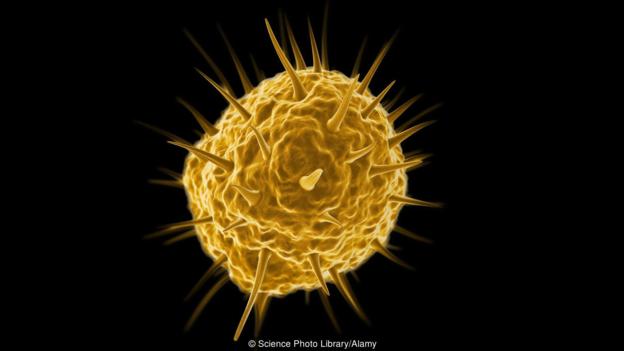
Mimivirus, an example of a giant virus (Credit: Science Photo Library/Alamy)

In a 2014 study, a team led by Claverie revived two viruses that had been trapped in Siberian permafrost for 30,000 years. Known as Pithovirus sibericum and Mollivirus sibericum, they are both "giant viruses", because unlike most viruses they are so big they can be seen under a regular microscope. They were discovered 100ft underground in coastal tundra.
Once they were revived, the viruses quickly became infectious. Fortunately for us, these particular viruses only infect single-celled amoebas. Still, the study suggests that other viruses, which really could infect humans, might be revived in the same way.
What's more, global warming does not have to directly melt permafrost to pose a threat. Because the Arctic sea ice is melting, the north shore of Siberia has become more easily accessible by sea. As a result, industrial exploitation, including mining for gold and minerals, and drilling for oil and natural gas, is now becoming profitable.
"At the moment, these regions are deserted and the deep permafrost layers are left alone," says Claverie. "However, these ancient layers could be exposed by the digging involved in mining and drilling operations. If viable virions are still there, this could spell disaster."
Giant viruses may be the most likely culprits for any such viral outbreak.
"Most viruses are rapidly inactivated outside host cells, due to light, desiccation, or spontaneous biochemical degradation," says Claverie. "For instance, if their DNA is damaged beyond possible repair, the virions will no longer be infectious. However, among known viruses, the giant viruses tend to be very tough and almost impossible to break open."


Neanderthals once lived in Siberia (Credit: The Natural History Museum/Alamy)

Claverie says viruses from the very first humans to populate the Arctic could emerge. We could even see viruses from long-extinct hominin species like Neanderthals and Denisovans, both of which settled in Siberia and were riddled with various viral diseases. Remains of Neanderthals from 30-40,000 years ago have been spotted in Russia. Human populations have lived there, sickened and died for thousands of years.

"The possibility that we could catch a virus from a long-extinct Neanderthal suggests that the idea that a virus could be 'eradicated' from the planet is wrong, and gives us a false sense of security," says Claverie. "This is why stocks of vaccine should be kept, just in case."
Since 2014, Claverie has been analysing the DNA content of permafrost layers, searching for the genetic signature of viruses and bacteria that could infect humans. He has found evidence of many bacteria that are probably dangerous to humans. The bacteria have DNA that encodes virulence factors: molecules that pathogenic bacteria and viruses produce, which increase their ability to infect a host.
Claverie's team has also found a few DNA sequences that seem to come from viruses, including herpes. However, they have not as yet found any trace of smallpox. For obvious reasons, they have not attempted to revive any of the pathogens.
It now seems that pathogens cut off from humans will emerge from other places too, not just ice or permafrost.


The crystals in the Naica cave (Credit: SOTK2011/Alamy)

In February 2017, NASA scientists announced that they had found 10-50,000-year-old microbes inside crystals in a Mexican mine.

The bacteria were located in the Cave of the Crystals, part of a mine in Naica in northern Mexico. The cave contains many milky-white crystals of the mineral selenite, which formed over hundreds of thousands of years.
The bacteria were trapped inside small, fluid pockets of the crystals, but once they were removed they revived and began multiplying. The microbes are genetically unique and may well be new species, but the researchers are yet to publish their work.
Even older bacteria have been found in the Lechuguilla Cave in New Mexico, 1,000ft underground. These microbes have not seen the surface for over 4 million years.\


Selenite formations in Lechuguilla Cave (Credit: Paul D. Stewart/naturepl.com)

The cave never sees sunlight, and it is so isolated that it takes about 10,000 years for water from the surface to get into the cave.

Despite this, the bacteria have somehow become resistant to 18 types of antibiotics, including drugs considered to be a "last resort" for fighting infections. In a study published in December 2016, researchers found that the bacteria, known as Paenibacillus sp. LC231, was resistant to 70% of antibiotics and was able to totally inactivate many of them.
As the bacteria have remained completely isolated in the cave for four million years, they have not come into contact with people or the antibiotic drugs used to treat human infections. That means its antibiotic resistance must have arisen in some other way.
The scientists involved believe that the bacteria, which does not harm humans, is one of many that have naturally evolved resistance to antibiotics. This suggests that antibiotic resistance has been around for millions or even billions of years.


Permafrost on the Tibetan plateau (Credit: Gertrud & Helmut Denzau/naturepl.com)

Obviously, such ancient antibiotic resistance cannot have evolved in the clinic as a result of antibiotic use.
The reason for this is that many types of fungi, and even other bacteria, naturally produce antibiotics to gain a competitive advantage over other microbes. That is how Fleming first discovered penicillin: bacteria in a petri dish died after one became contaminated with an antibiotic-excreting mould.
In caves, where there is little food, organisms must be ruthless if they are to survive. Bacteria like Paenibacillus may have had to evolve antibiotic resistance in order to avoid being killed by rival organisms.
This would explain why the bacteria are only resistance to natural antibiotics, which come from bacteria and fungi, and make up about 99.9% of all the antibiotics we use. The bacteria have never come across man-made antibiotics, so do not have a resistance to them.
"Our work, and the work of others, suggests that antibiotic resistance is not a novel concept," says microbiologist Hazel Barton of the University of Akron, Ohio, who led the study. "Our organisms have been isolated from surface species from 4-7 million years, yet the resistance that they have is genetically identical to that found in surface species. This means that these genes are at least that old, and didn't emerge from the human use of antibiotics for treatment."
Although Paenibacillus itself is not harmful to humans, it could in theory pass on its antibiotic resistance to other pathogens. However, as it is isolated beneath 400m of rock, this seems unlikely.
Nevertheless, natural antibiotic resistance is probably so prevalent that many of the bacteria emerging from melting permafrost may already have it. In line with that, in a 2011 study scientists extracted DNA from bacteria found in 30,000-year-old permafrost in the Beringian region between Russia and Canada. They found genes encoding resistance to beta-lactam, tetracycline and glycopeptide antibiotics.
How much should we be concerned about all this?
One argument is that the risk from permafrost pathogens is inherently unknowable, so they should not overtly concern us. Instead, we should focus on more established threats from climate change. For instance, as Earth warms northern countries will become more susceptible to outbreaks of "southern" diseases like malaria, cholera and dengue fever, as these pathogens thrive at warmer temperatures.
The alternative perspective is that we should not ignore risks just because we cannot quantify them.
"Following our work and that of others, there is now a non-zero probability that pathogenic microbes could be revived, and infect us," says Claverie. "How likely that is is not known, but it's a possibility. It could be bacteria that are curable with antibiotics, or resistant bacteria, or a virus. If the pathogen hasn't been in contact with humans for a long time, then our immune system would not be prepared. So yes, that could be dangerous."

  • By Jasmin Fox-Skelly


понедельник, 8 мая 2017 г.

FAVORITE IMAGES OF THE WEEK - 14

THE PRAWN
Astrophotographer Dieter Willasch created this great shot of the Prawn Nebula, in the tail of Scorpius. It's about 6,000 light-years away. Read more here.
Dieter Willasch


NOT FROM OUTER SPACE
This image may look like it's capturing a faraway star or some other celestial body, but it's not--it's actually the first-ever snapshot of an individual atom's shadow. Read more here.
Kielpinski Group, Griffith University


FOURTH/MOON
Another great fireworks shot, this was taken in Kansas City, Kansas, where the fireworks and the moon both lit up the sky. For more great photojournalism like this, check out American Photo.
AP Photo/Charlie Riedel


SIFTING STARLIGHT
New tech offers a better view of exoplanets by using advanced optics to remove the starlight from a photograph. Here's a look at HD 157728, a nearby star 1.5 times larger than the sun. Be sure to check out the whole story here.
Project 1640/NASA-JPL


DARK GALAXIES
For the first time, astronomers have been able to get a better look at starless "dark galaxies," theorized to exist but never directly seen. Even now, it takes some annotation in this image. The quasar lighting them up is circled in red; the dark galaxies are circled in blue. Read the whole story here.
Royal Astronomical Society


MARS PANORAMA
It took 817 images to create a composite panoramic view from NASA's Mars rover, but the results are worth the effort, offering a rare glimpse of the red planet. For more on the image, check out PopPhoto.
NASA


STUNNED FISH
Scientists are using an electric current, shown here, to stun fish in Mississippi and Illinois rivers so they can be studied. It's thought the local fish populations might be hurt by the arrival of Asian Carp, and researchers are scooping up the stunned fish for a closer look.
AP Photo/Robert Ray


The "Pain Matrix"


воскресенье, 7 мая 2017 г.

3 Golden Rules When Selecting Your Temperature Control Solution


When it comes to protecting pharmaceutical products from temperature excursions, there is a wide offer of different solutions available on the market. From thermal wrapping to active solutions, each and every solution has its pros and cons.

What you need to know prior the selection of the solution

 I would like to focus on three main parameters that will affect the selected solution

1.      The category your pharmaceutical products

When moving your pharmaceutical goods, you need to know what temperature deviation the goods can handle, by how much and how long. Some products are stated to be stored and moved in temperature that needs to be 15°C and 25°C, but can handle excursion over and under this requirement. This would allow selecting a more flexible and cheaper solution in order to move the goods.

2.      The lane selected

When shipping goods from point A to point B, your goods won’t necessarily travel directly, and it won’t be the case for many situations. Therefore, the route that your goods will be going though needs to be assed with a line risk assessments (LRA). This will allow you to minimize the risk of temperature excursion to your product while assuring that your goods are travelling in the most efficient way. You may want to favor lay over at key airports in EU such as Brussels, first airport to be CEIV certified – Excellence in Pharmaceutical Logistics – by the IATA, or Frankfort, where they are equipped with vast GDP certified facilities directly at the airport.
Transiting by the Gulf region, you might want to transit through Abu Dhabi airport, where they are equipped with cooling dollies on the tarmac.

3.      The airfreight service

Most of major airlines have what we can call a pharma service option for airfreight shipments. The name might vary from one airline to another, and from one freight forwarder to another, but basically says the same: it provide a certain degree of temperature controlling processes, such as a special compartment on the aircraft, or a model of last out of the airport storage facility and first in the aircraft in order to minimize tarmac exposure time.

Selecting the proper solution

Nowadays, there is a vast portfolio of product to control temperature on aircraft, from simple thermo wrapping, to active solutions, such as Envirotainer, with multiple choices in between. In the last few years, technology has evolved significantly for the category of passive shippers, both for pallets or single boxes. In this category, you can find single use or reusable solutions, depending on the network in which your goods are moving.
Cost wise, usually thermo wrapping and thermo blankets are the cheapest, but in use with an airline pharma service along with a rigorous line risk assessment, they can become a very cost optimal solution for a 15°C - 25°C requirement. You need to cover the top and walls of your goods, but do not forget to also cover the base of your pallet, as in summer, most of the heat comes from the tarmac.
Performance wise, passive solutions such as pallet shippers are now days very reliable and high performing. They can be used for both 15°C - 25°C and 2°C - 8°C shipments in a reliable way. Also, they can come in quite cost efficient for a company that does inbound and outbound shipments. Most of those passive solution manufacturers provide a guide to reuse them.
Last one would be the active solution. Definitely a reliable solution, but the biggest advantage is the how easy the solution is to use. Simply setup at the required temperature, load your goods into the solution once the temperature as reach the required degree and you are good to go.
Keep in mind those three key points:
  1. No matter what solution you are using, make sure you track the temperature through all of the trip of your goods
  2. Involve your quality and compliance team, as those solution would most likely need to be validated
  3. Cost is not the only thing – quality and compliance is also a big factor to make the right decision