Показаны сообщения с ярлыком space exploration. Показать все сообщения

среда, 28 мая 2025 г.

The Closest Photo of Saturn Ever Taken


Captured by NASA’s Cassini spacecraft during its Grand Finale dive in 2017, this is the closest we’ve ever seen Saturn. Just 1,200 kilometers (745 miles) above the cloud tops, Cassini dove between the planet and its rings — a region no spacecraft had dared to explore before.

Look closely and you can see the stunning detail of Saturn’s upper atmosphere — the swirling clouds, the subtle hues, the raw power of a gas giant in our own solar system.

This image isn't just a photo — it’s a farewell. Cassini took this shot before diving into Saturn’s atmosphere and ending its mission, burning up to protect Saturn’s moons from contamination.

✨ A final kiss from a robot explorer to the ringed giant it loved.


https://tinyurl.com/k2ap4ns7

четверг, 7 ноября 2024 г.

Comparing the Size of The World’s Rockets, Past and Present


By 

The Size of The World’s Rockets, Past and Present

The SpaceX Starship might be the next rocket to take humans to the moon, but it won’t be the first, and likely not the last.

Starting in the mid-20th century, humanity has explored space faster than ever before. We’ve launched satellites, telescopes, space stations, and spacecrafts, all strapped to rocket-propelled launch vehicles that helped them breach our atmosphere.

This infographic from designer Tyler Skarbek stacks up the many different rockets of the world side-by-side, showing which country designed them, what years they were used, and what they (could) accomplish.

How Do The World’s Rockets Stack Up?

Before they were used for space travel, rockets were produced and developed to be used as ballistic missiles.

The first rocket to officially reach space—defined by the Fédération Aéronautique Internationale as crossing the Kármán line at 100 kilometers (62 miles) above Earth’s mean sea level—was the German-produced V-2 rocket in 1944.

But after World War II, V-2 production fell into the hands of the U.S., the Soviet Union (USSR), and the UK.

Over the next few decades and the unfolding of the Cold War, what started as a nuclear arms race of superior ballistic missiles turned into the Space Race. Both the U.S. and the USSR tried to be the first to achieve and master spaceflight, driving production of many new and different rockets.

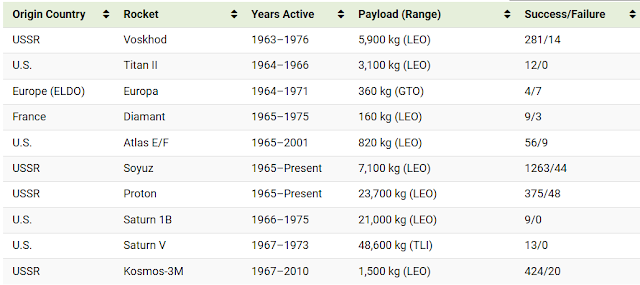


As the Space Race wound down, the U.S. proved to be the biggest producer of different rockets. The eventual dissolution of the USSR in 1991 transferred production of Soviet rockets to Russia or Ukraine. Then later, both Europe (through the European Space Agency) and Japan ramped up rocket production as well.

More recently, new countries have since joined the race, including ChinaIran, and India. Though the above infographic shows many different families of rockets, it doesn’t include all, including China’s Kuaizhou rocket and Iran’s Zuljanah and Qased rockets.

Rocket Range Explained and Continued Space Aspirations

Designing a rocket that can reach far into space while carrying a heavy payload—the objects or entities being carried by a vehicle—is extremely difficult and precise. It’s not called rocket science for nothing.

When rockets are designed, they are are created with one specific range in mind that takes into account the fuel needed to travel and velocity achievable. Alternatively, they have different payload ratings depending on what’s achievable and reliable based on the target range.

  • Suborbital: Reaches outer space, but its trajectory intersects the atmosphere and comes back down. It won’t be able to complete an orbital revolution or reach escape velocity.
  • LEO (Low Earth orbit): Reaches altitude of up to ~2,000 km (1242.74 miles) and orbits the Earth at an orbital period of 128 minutes or less (or 11.25 orbits per day).
  • SSO (Sun-synchronous orbit): Reaches around 600–800 km above Earth in altitude but orbits at an inclination of ~98°, or nearly from pole to pole, in order to keep consistent solar time.
  • GTO (Geosynchronous transfer orbit): Launches into a highly elliptical orbit which gets as close in altitude as LEO and as far away as 35,786 km (22,236 miles) above sea level.
  • TLI (Trans-lunar injection): Launches on a trajectory (or accelerates from Earth orbit) to reach the Moon, an average distance of 384,400 km (238,900 miles) from Earth.

But there are other ranges and orbits in the eyes of potential spacefarers. Mars for example, a lofty target in the eyes of SpaceX and billionaire founder Elon Musk, is between about 54 and 103 million km (34 and 64 million miles) from Earth at its closest approach.

With space exploration becoming more common, and lucrative enough to warrant billion-dollar lawsuits over contract awards, how far will future rockets go?

https://tinyurl.com/2s46765p


пятница, 29 октября 2021 г.

Our Galaxy is Caught Up in a Giant Cosmic Cobweb!


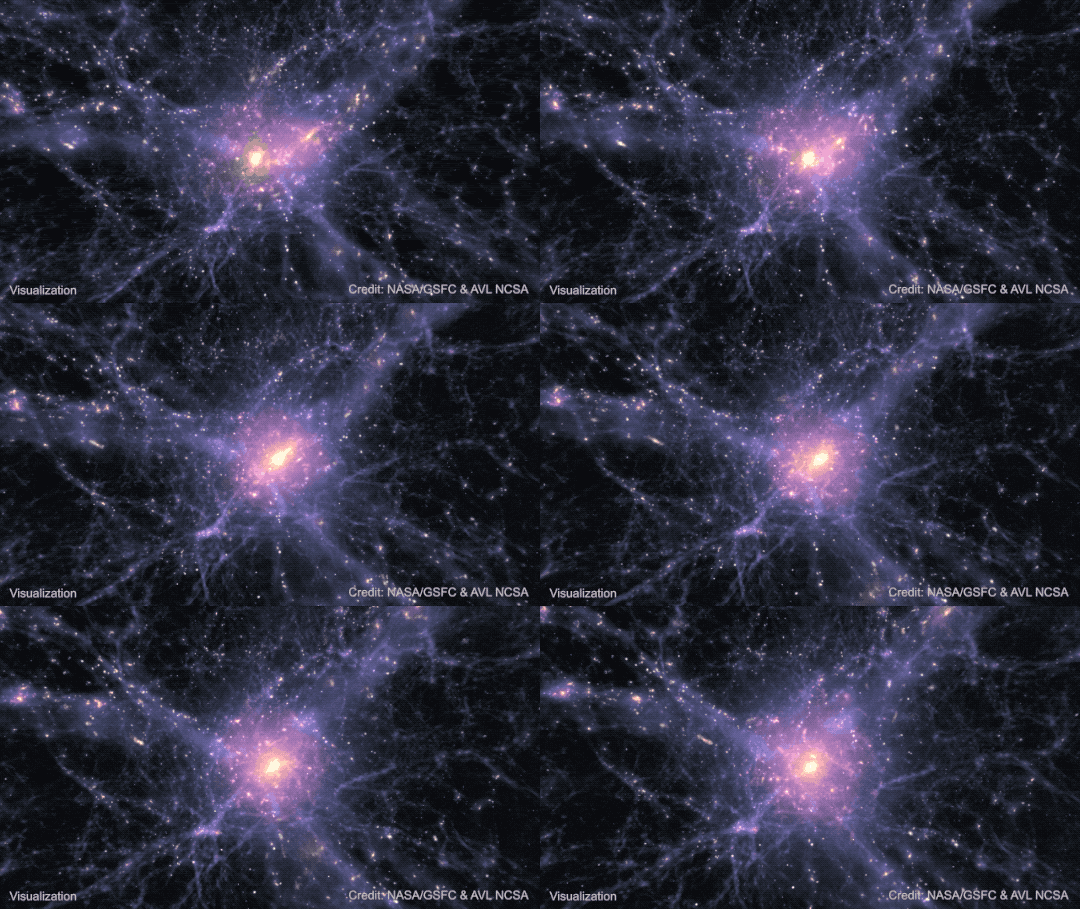
If we could zoom waaaay out, we would see that galaxies and galaxy clusters make up large, fuzzy threads, like the strands of a giant cobweb. But we'll work our way out to that. First let's start at home and look at our planet's different cosmic communities.

Our home star system

Earth is one of eight planets — Mercury, Venus, Earth, Mars, Jupiter, Saturn, Uranus, and Neptune — that orbit the Sun. But our solar system is more than just planets; it also has a lot of smaller objects.


An asteroid belt circles the Sun between Mars and Jupiter. Beyond Neptune is a doughnut-shaped region of icy objects called the Kuiper Belt. This is where dwarf planets like Pluto and Makemake are found and is likely the source of short-period comets (like Haley’s comet), which orbit the Sun in less than 200 years.

Scientists think that even farther out lies the Oort Cloud, also a likely source of comets. This most distant region of our solar system is a giant spherical shell storing additional icy space debris the size of mountains, or larger! The outer edge of the Oort Cloud extends to about 1.5 light-years from the Sun — that’s the distance light travels in a year and a half (over 9 trillion miles).


Sometimes asteroids or comets get ejected from these regions and end up sharing an orbit with planets like Jupiter or even crossing Earth’s orbit. There are even interstellar objects that have entered the inner solar system from even farther than the Oort Cloud, perhaps coming all the way from another star!

Our home galaxy

Let's zoom out to look at the whole Milky Way galaxy, which contains more than 100 billion stars. Many are found in the galaxy’s disk — the pancake-shaped part of a spiral galaxy where the spiral arms lie. The brightest and most massive stars are found in the spiral arms, close to their birth places. Dimmer, less massive stars can be found sprinkled throughout the disk. Also found throughout the spiral arms are dense clouds of gas and dust called nebulae. The Sun lies in a small spiral arm called the Orion Spur.


The Milky Way’s disk is embedded in a spherical “halo” about 120,000 light-years across. The halo is dotted with globular clusters of old stars and filled with dark matter. Dark matter doesn’t emit enough light for us to directly detect it, but we know it’s there because without its mass our galaxy doesn’t have enough gravity to hold together!

Our galaxy also has several orbiting companion galaxies ranging from about 25,000 to 1.4 million light-years away. The best known of these are the Large and Small Magellanic Clouds, which are visible to the unaided eye from Earth’s Southern Hemisphere.

Our galactic neighborhood


The Milky Way and Andromeda, our nearest neighboring spiral galaxy, are just two members of a small group of galaxies called the Local Group. They and the other members of the group, 50 to 80 smaller galaxies, spread across about 10 million light-years.

The Local Group lies at the outskirts of an even larger structure. It is just one of at least 100 groups and clusters of galaxies that make up the Virgo Supercluster. This cluster of clusters spans about 110 million light-years!


Galaxies aren’t the only thing found in a galaxy cluster, though. We also find hot gas, as shown above in the bright X-ray light (in pink) that surrounds the galaxies (in optical light) of cluster Abell 1413, which is a picturesque member of a different supercluster. Plus, there is dark matter throughout the cluster that is only detectable through its gravitational interactions with other objects.

The Cosmic Web

The Virgo Supercluster is just one of many, many other groups of galaxies. But the universe’s structure is more than just galaxies, clusters, and the stuff contained within them.


For more than two decades, astronomers have been mapping out the locations of galaxies, revealing a filamentary, web-like structure. This large-scale backbone of the cosmos consists of dark matter laced with gas. Galaxies and clusters form along this structure, and there are large voids in between.

The scientific visualizations of this “cosmic web” look a little like a spider web, but that would be one colossal spider!

And there you have the different communities that define Earth’s place in the universe. Our tiny planet is a small speck on a crumb of that giant cosmic web!

https://bit.ly/3nJtP8O

воскресенье, 19 сентября 2021 г.

Five Reasons why Aliens might Exist


When we’re contemplating the existence of life beyond our planet, it’s worth considering that we’ve discovered microbes inhabiting spaces on Earth where the idea of survival was previously inconceivable. These lifeforms are based on familiar DNA – so it’s life as we know it – but they exist in the deep trenches of our oceans, far away from sunlight. In the past, we believed life could only exist on a planet, a certain distance from its local star (so it has the right levels of radiation). Finding life on Earth thriving where we didn’t think it possible has opened our eyes to the concept that there might be moons able to support life too. We’ve only been actively reaching out for alien life for about a century — a mere blip in the long history of the solar system and of the universe overall. Evan Solomonides, an astrophysics and mathematics undergrad and researcher at Cornell University, suggests that it could take a while — about 1,500 years from now, to be precise — before we hear from any extraterrestrials.
In a paper submitted to the American Astronomical Society, Solomonides examines the probability of finding life. “We predict that under 1 percent of the galaxy has been reached at all thus far, and we do not anticipate to be reached until approximately half of the stars/planets have been reached.” Solomonides believes that we will have explore around half of the Milky Way galaxy before we hear anything, which will take a while since we’ve barely explored our own galactic neighborhood.


https://bit.ly/3tT6K6f

понедельник, 26 августа 2019 г.

Первая съемка Плутона / The first shooting of Pluto


Плуто́н — крупнейшая известная карликовая планета Солнечной системы, транснептуновый объект и десятое по массе небесное тело, обращающееся вокруг Солнца — после восьми планет и Эриды. Первоначально Плутон считали планетой, но сейчас он считается карликовой планетой и крупнейшим объектом пояса Койпер
Радиус1 188,3 км
Открытие18 февраля 1930 г.
Перигелий29,667 а. е.

Pluto (minor planet designation134340 Pluto) is a dwarf planet in the Kuiper belt, a ring of bodies beyond Neptune. It was the first Kuiper belt object to be discovered and is the largest known plutoid (or ice dwarf)
It is the ninth-largest and tenth-most-massive known object directly orbiting the Sun. It is the largest known trans-Neptunian object by volume but is less massive than Eris. Like other Kuiper belt objects, Pluto is primarily made of ice and rock and is relatively small—about one-sixth the mass of the Moon and one-third its volume. It has a moderately eccentric and inclined orbit during which it ranges from 30 to 49 astronomical units or AU (4.4–7.4 billion km) from the Sun. This means that Pluto periodically comes closer to the Sun than Neptune, but a stable orbital resonance with Neptune prevents them from colliding. Light from the Sun takes about 5.5 hours to reach Pluto at its average distance (39.5 AU).
Mean radius
Flattening<1%[6]
  • 1.779×10⁷ km2[c]
  • 0.035 Earths
Volume
  • (7.057±0.004)×109 km3[d]
  • 0.00651 Earths
Mass
Mean density
1.854±0.006 g/cm3[4][6]
1.212 km/s[f]
Sidereal rotation period
  • 6.387230 d
  • 6 d, 9 h, 17 m, 36 s
Equatorial rotation velocity
47.18 km/h
122.53° (to orbit)[1]
North pole right ascension
132.993°[7]
North pole declination
−6.163°[7]
Albedo0.49 to 0.66 (geometric, varies by 35%)[1][8]
Surface temp.minmeanmax
Kelvin33 K44 K (−229 °C)55 K
13.65[1] to 16.3[9]
(mean is 15.1)[1]
−0.7[10]
0.06″ to 0.11″[1][g]
Atmosphere
Surface pressure
1.0 Pa (2015)[6][12]
Composition by volumeNitrogenmethanecarbon monoxide[11]