
NASA/Clouds AO/SEArch
Home Sweet Icy Martian Home
Long-term exposure to radiation is one of the biggest threats to human health in space. But these cute, cozy-looking ice domes could help. The hydrogen found in ice is an excellent shield against the radiation that exists outside of Earth's protective atmosphere. These domes are inflatable, with an outer layer that gets filled with water and freezes, providing a welcoming, radiation-free living space. So if we ever do make it to the red planet, the Mars Ice Homes, as they are called, could be real life savers.
NASA/JSC
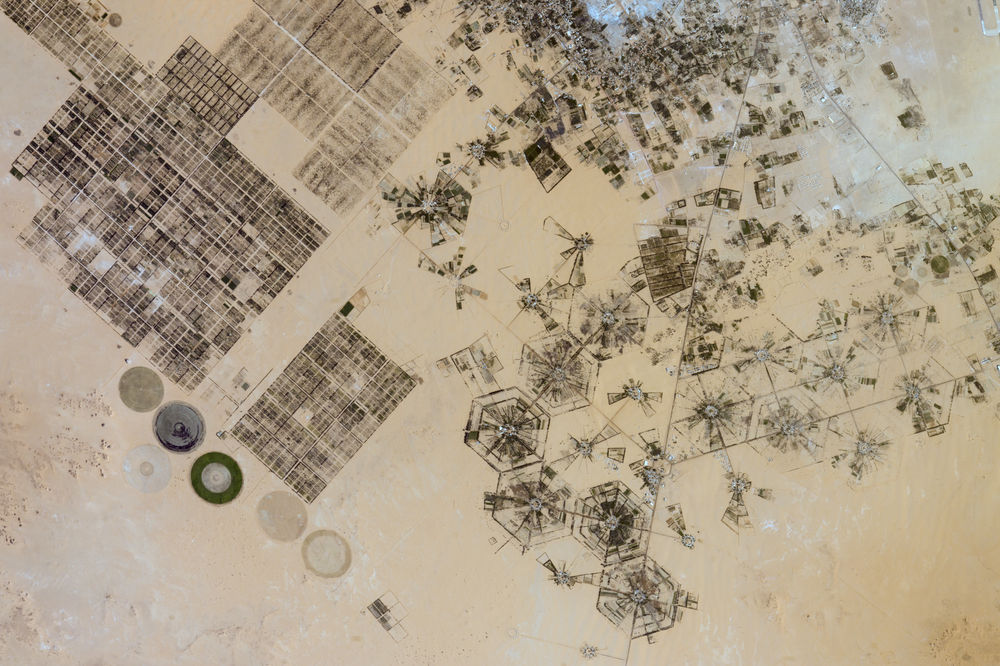
A Farming Community Seen From Space
This image, taken aboard the International Space Station, displays one of the most remote areas of Africa: a farming region in Eastern Libya. The cluster of houses and roads in the upper right show a town called Al Jawf, which is about 900 miles from the nearest city. The different geometric configurations each represent a different irrigation method that's been tried. The honeycombs came first, followed by the large circles, which are center-pivot irrigation systems implemented to conserve water. Al Jawf gets its water from the Nubian Sandstone Aquifer, the largest fossil water aquifer on Earth.

Cincinnati Children's
Digestion In A Petri Dish
This is no ordinary stomach. This piece of tissue, blown up under a microscope, didn't come from someone's gut. A group of scientists from Cincinnati Children's Hospital grew it, cell by cell, in a lab. With a working mini-stomach at their disposal, scientists can test new drugs, better understand current ones, and figure out how to grow bits of stomach and intestines for people who need them.

NASA/CXC/Penn State/B.Luo et al.
How Many Black Holes Do You See?
Nearly 70 percent of the tiny dots in this image are supermassive black holes—areas of intense gravity that pull in all matter around them. NASA scientists created this image by piecing together 7 million seconds of footage from the Chandra X-ray Observatory. By observing black holes in this way, scientists can figure out how they formed. They think that supermassive black holes that developed in the early days of the Universe came about in quick bursts, as opposed to forming steadily overtime.

BMW
Comfy Future Cars
The future of car travel is looking pretty darn cozy. This week, at the Consumer Electronics Showcase (CES) in Las Vegas, BMW demonstrated what they think the inside of cars will look like in 5 years. Their concept features comfortable seating and lots of storage for books and electronics in every seat of the car, including the driver's seat—features that highlight the fact that cars will one day drive us, and not the other way around.

Alan Place/University of Limerick
New Year, New Organ
Your mesentery—sections of connective tissue that keep your gastrointestinal organs in place—has been somewhat neglected in the medical community. Despite its important work, doctors and researchers never considered the structure to be its own organ, because it wasn't thought to be one continuous, multilayer structure. But a group of scientists are the University of Limerick took a second look and found that this vital structure does indeed pass these requirements. This reclassification could help scientists better understand its potential role in chronic, hard-to-treat gastrointestinal diseases, like Crohn's and irritable bowel syndrome.

