Показаны сообщения с ярлыком Earth. Показать все сообщения

воскресенье, 31 мая 2026 г.

What Earth Would Look Like If Only 100 People Lived Here


If Earth had just 100 people:
↳ 34 doesn't have internet
↳ 13 can't read or write
↳ 8 don't have clean water
↳ 8 live on less than $2 a day

And you're reading this on LinkedIn.
Think about that for a second.

The truth is:
You're already in the top 1%

7 ways to use your luck to get unstuck:

1/ Turn Knowledge Into Action
↳ Pick one course (not five)
↳ Study 25 mins every morning
↳ Teach someone what you learned

2/ Create Your Success Routine
↳ Wake up 45 mins earlier
↳ Read 10 pages before screens
↳ Write 3 goals before email
↳ Small wins compound quickly

3/ Build Real Connections
↳ Message 2 new people daily
↳ Share their wins (not just yours)
↳ Ask how you can help them

4/ Master Your Money
↳ Learn one money skill monthly
↳ Track every dollar for 30 days
↳ Knowledge equals freedom

5/ Boost Your Energy
↳ Walk 15 mins at lunch
↳ Sleep 7+ hours (non-negotiable)
↳ High energy unlocks everything else

6/ Create Instead of Consume
↳ Write one helpful post weekly
↳ Share three lessons you learned
↳ Build something small daily

7/ Practice Deep Gratitude
↳ List 3 unique blessings daily
↳ Help one person without asking
↳ Grateful people grow faster


https://tinyurl.com/ycx6umj3

https://cutt.ly/dt1J7mqa

пятница, 2 апреля 2021 г.

Earth has been hiding a fifth layer in its inner core


Scientists say they've detected a new, mysterious layer at the center of our home planet. The discovery could unearth more about Earth's history.


One of geology's basic principles is that the Earth is made up of four layers: the crust, the mantle, the outer core, and the inner core. But this may be squashed in light of a new study that suggests Earth actually has a distinct fifth layer that's been under our feet all along.

Researchers at the Australian National University (ANU) say that the new layer they uncovered is located within Earth's inner core. Deeper analysis of this discovery could help scientists better understand our planet's history and evolution.

A peek inside Earth

Approximately 4.6 billion years ago, the Earth formed. The story starts with the planet's interior or rocky core, which formed through the collision of heavy elements. The core, found at the center of the Earth, is made up of two parts. The outer layer, comprised of liquid iron alloy, is about 1,355 miles thick. The outer core is also thought to be responsible for Earth’s magnetic field. In contrast, the inner core is made up of solid iron alloy with a radius of 760 miles.

Next comes the mantle, which sits directly above the core. This layer is composed of mostly silicate rocks that are rich in magnesium and iron. The mantle has a thickness of about 1,793 miles, making it Earth's thickest layer. The thinnest and most brittle layer is the crust, however. It varies between 18.6 to 43.5 miles in thickness and forms the outermost layer of our home planet.

Earth's layers before the discovery of the innermost-inner core. The newest layer is situated just below the inner core.
OSweetNature/Shutterstock

The fifth layer

Scientists have long suspected that Earth's inner core was made of two layers. But it wasn't until ANU researchers took a closer look at what lies below that an “innermost inner core" was confirmed.

Their work revealed a distinct change in the structure of iron deep within the inner core at about 3,604 miles below the Earth's surface. You may recall from earlier that the inner core consists of solid iron alloy. This is due to high pressure deep within the Earth that stops the iron alloy from melting. But distinct structural changes were detected in this iron alloy that set apart the newly discovered innermost layer from the rest of the inner core.

According to Salon, this discovery led the researchers to believe that the change in structure may have been caused by an unknown, dramatic event early in Earth’s history. Further examination of this tiny layer may provide additional details around how our planets formed.

“The details of this big event are still a bit of a mystery, but we've added another piece of the puzzle when it comes to our knowledge of the Earths' inner core,” said the study’s lead author and researcher, Joanne Stephenson, in a statement.

Behind the scenes of the discovery

Seismic monitoring allows us to gain a better understanding of Earth's interior. This is made possible by measuring sound waves that are created by earthquakes and pass through Earth's layers. By analyzing how the different layers cause the sound waves to slow down, scientists can catch a glimpse of what lies below.

The recent discovery was made with the aid of a special search algorithm that researchers used to compare thousands of models of the inner core with decades worth of data on how long seismic waves take to travel through Earth. This data, gathered by seismograph stations all over the world, helped detect the changes in the structure of iron in the inner core. These findings helped confirm that Earth’s inner core has another layer.

Although this work is still being analyzed, the discovery of a new layer may pave the way for a new geological principle and prompt textbooks to be rewritten.


https://bit.ly/3sMZmIs

вторник, 30 мая 2017 г.

FAVORITE IMAGES OF THE WEEK - 15


Living and breathing

Hannah Cohen / MIT
1 of 5
Most of us sweat a lot when we work out. And while many workout clothes today have been specifically designed to help sweat evaporate more easily, none of them had done so using bacteria. Until now. A group of researchers at MIT developed a prototype that uses B. subtilis—when it comes in contact with sweat, it absorbs the moisture and relaxes, allowing the clothing to relax, too. The researchers say this new tech is just a stepping stone on the way to developing a shirt that can also make your sweat smell good.


No dye needed

Joshua Stevens/NASA
2 of 5
This lake isn't great for swimming. Located in Northern Tanzania, Lake Natron is one of the most inhospitable places in the world. Because its located just beneath a volcano, the lake receives a steady supply of molten lava, the contents of which turns the lake its fiery red color. While most living creatures wouldn't survive one second in that water, some salt-loving extremist bacteria bask in the briny depths. The image here of the lake was taken this past March via the The Operational Land Imager (OLI) on Landsat 8.


Lift off

Rocket Lab
3 of 5
New Zealand's first commercial rocket took to the skies this week, following three scrubbed attempts. The Electron Rocket, which belongs to New Zealand's Rocket Lab company, stands only at 55 feet tall. It could become an inexpensive way to place small satellite systems into space.


Jupiter up close

NASA/JPL-Caltech/SwRI/MSSS/Betsy Asher Hall/Gervasio Robles
4 of 5
New images from NASA's Juno mission, which launched in 2011 and went into orbit around Jupiter in August of last year, show the gassy planet's turbulent atmosphere. This one, which NASA just released this past week, shows that both of Jupiter's poles contain swirling storms the size of Earth.


Shape shifters

Michael Indresano Production
5 of 5
Can't decide on what shape of pasta you want? Perhaps one day you might not have to. A group of researchers from MIT used the adaptive absorption of gelatin to develop a pasta sits flat in its packaging, but then forms into 3D shapes when it comes into contact with water. With some more research, they think consumers could even design their own shapes at home. Here's a cool video of the process in action.


пятница, 28 апреля 2017 г.

FAVORITE IMAGES OF THE WEEK - 9

Gerardo Aizpuru
Jewel Caterpillar
The Jewel Caterpillar--probably, though it hasn't been formally confirmed, an Acraga coa, belonging to a family of moths known as Alceridae--is sometimes known as a "slug caterpillar" due to gooeyness. This one was photographed near Cancun, Mexico. [via BoingBoing]

NASA/JPL-Caltech
Super Earth
This artist's concept of a so-called "super Earth" is a representation of a first-of-its-kind view that NASA's Spitzer Space Telescope caught this week. For the first time, we've seen direct light from a super Earth, "using its sensitive heat-seeking infrared vision." The planet is incredibly close to the star it orbits, and probably has a rocky core surrounded by both liquid and gaseous water. Read more here.

Wikimedia Commons
London Rooftop Missiles
We learned last week that, to protect the games or possibly just freak us the hell out, some London residents will play host to rooftop missiles during the Olympics. Here's what that missile will look like: a Starstreak High Velocity Missile. Read more here.

Tony LaCasse/New England Aquarium
Calico Lobster
This is a calico lobster. Caught off the coast of Maine, it was originally going to be eaten, because obviously, lobsters are delicious, that's what you do with them. But it's weird coloration (only 1 in 30 million are colored this way) led it to the New England Aquarium instead. Read more here.

Reuters/Darley Shen
DIY Double-Seater Sub
Zhang Wuyi, a farmer, created this double-seater sub--one of six. To see more photojournalism like this, head over to American Photo Mag.

USGS
Earth as Art
The U.S. Geological Survey occasionally exhibits some of the amazing satellite imagery taken of our planet--even though the satellite is for scientific purposes, sometimes it produces just stunningly beautiful images. Read more here.

BIG

Skyscraper

A Danish architecture firm called BIG have designed an apartment building, or group of buildings, or something, that is/are shaped like a hashtag. #Unlikely but #supercool. Read more here.

NASA/JPL-Caltech
Black Hole Revs Up
This artist's concept of the galaxy Arp 220 is based on data picked up by the Hubble Space Telescope. It's meant to show how a black hole that's revving up in power can suppress a galaxy's ability to birth new stars. Read more here.

Wenceslao T. Medina, Andre ́s A. de la Llera, Juan L. Condori, and Jose ́ M. Aguilera
Cereal Science
In one of our favorite stories of the week, a team of scientists sought to answer a question that has plagued absolutely nobody for absolutely no time: why does cereal taste better with milk than with water? Included in the article (which had amazing quotes) were these precise/hilarious magnified shots of soggy breakfast cereal.


четверг, 30 марта 2017 г.

The 10 best science images, videos, and visualizations of the year

These are the 2017 winners of the Vizzies Challenge.

воскресенье, 5 февраля 2017 г.

FAVORITE IMAGES OF THE WEEK - 6

NASA
Beauty In The World
NASA's GOES-16 satellite, which launched in November of last year, sent back its first images to Earth this week—and they are gorgeous. The satellite captures images in 16 different wavelengths of light, allowing scientists to better study atmospheric conditions. In the process, it makes some really nice looking images of our lovely planet. Don't believe me? Take a closer look here.

Smithsonian/National Zoo
Cuteness Needed
Zoos and aquariums across the country decided we needed an infusion of cuteness after this long week of political news. So they started a #cuteanimaltweetoff on Twitter, with each facility posting the cutest animal photo they have. If you need a bright spot in your day, this is sure to cheer you up. Here's a newborn female gray seal pup, born on Saturday at the National Zoo and posted on the Smithsonian's twitter account.

NASA/JPL-Caltech/Space Science Institute
Death Star Moon
This is not a screenshot from Star Wars. It's a moon in our solar system that looks eerily similar to the Death Star. Orbiting Saturn, Tethys boasts a huge, suspiciously cinematic crater.

Jose C. E. Mendoza
Harry The Crab
Meet the newest Harry Potter character—except this one doesn't do magic. Instead, you can find him crawling around near the coast of Guam. A group of researchers announced this week that the newest species of crab discovered would be named Harryplax severus, a combination of the main character in the popular children's book series and the misunderstood Severus Snape.

Firefighting Jetpack
Yes, that's a man in a jetpack, and yes, he's putting out a fire. First responders in Dubai tested out the new Dolphin jetpack this week. The system seems to lift the rider into the air via a tube, allowing him a better angle for putting out the fire. Read our take on how it works here.

Boeing
Sky High Fashion
The first astronauts traveling to space with private companies are going to fly in style. Boeing just released its new spacesuit, which is meant to be more comfortable and less bulky than NASA's current offerings. Hopefully it will be just as functional, too.


суббота, 21 января 2017 г.

FAVORITE IMAGES OF THE WEEK - 4

NASA/Clouds AO/SEArch
Home Sweet Icy Martian Home
Long-term exposure to radiation is one of the biggest threats to human health in space. But these cute, cozy-looking ice domes could help. The hydrogen found in ice is an excellent shield against the radiation that exists outside of Earth's protective atmosphere. These domes are inflatable, with an outer layer that gets filled with water and freezes, providing a welcoming, radiation-free living space. So if we ever do make it to the red planet, the Mars Ice Homes, as they are called, could be real life savers.


NASA/JSC
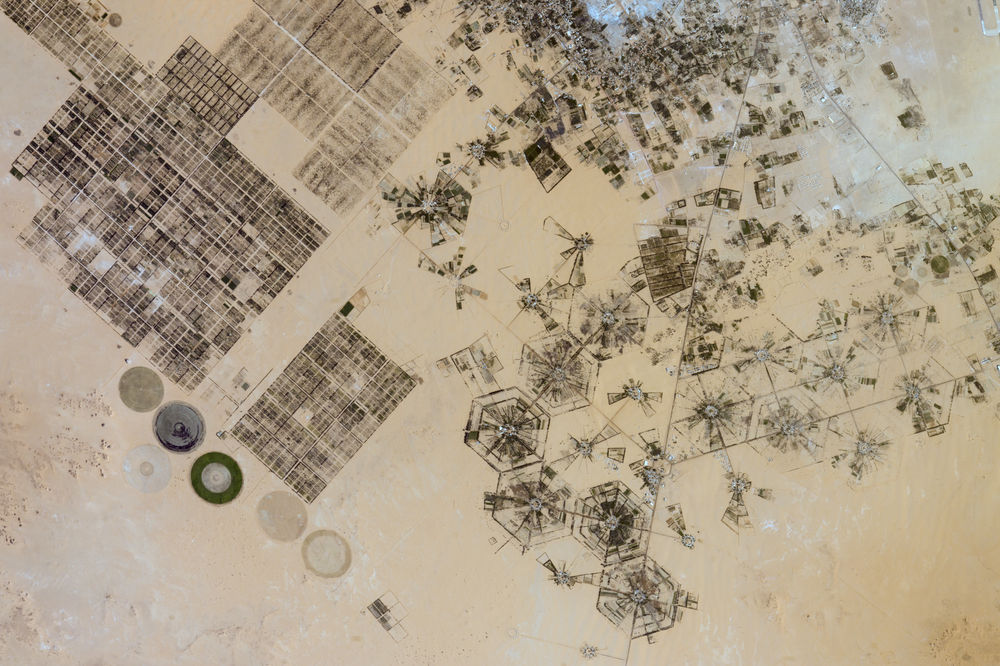
A Farming Community Seen From Space
This image, taken aboard the International Space Station, displays one of the most remote areas of Africa: a farming region in Eastern Libya. The cluster of houses and roads in the upper right show a town called Al Jawf, which is about 900 miles from the nearest city. The different geometric configurations each represent a different irrigation method that's been tried. The honeycombs came first, followed by the large circles, which are center-pivot irrigation systems implemented to conserve water. Al Jawf gets its water from the Nubian Sandstone Aquifer, the largest fossil water aquifer on Earth.

Cincinnati Children's
Digestion In A Petri Dish
This is no ordinary stomach. This piece of tissue, blown up under a microscope, didn't come from someone's gut. A group of scientists from Cincinnati Children's Hospital grew it, cell by cell, in a lab. With a working mini-stomach at their disposal, scientists can test new drugs, better understand current ones, and figure out how to grow bits of stomach and intestines for people who need them.

NASA/CXC/Penn State/B.Luo et al.
How Many Black Holes Do You See?
Nearly 70 percent of the tiny dots in this image are supermassive black holes—areas of intense gravity that pull in all matter around them. NASA scientists created this image by piecing together 7 million seconds of footage from the Chandra X-ray Observatory. By observing black holes in this way, scientists can figure out how they formed. They think that supermassive black holes that developed in the early days of the Universe came about in quick bursts, as opposed to forming steadily overtime.

BMW
Comfy Future Cars
The future of car travel is looking pretty darn cozy. This week, at the Consumer Electronics Showcase (CES) in Las Vegas, BMW demonstrated what they think the inside of cars will look like in 5 years. Their concept features comfortable seating and lots of storage for books and electronics in every seat of the car, including the driver's seat—features that highlight the fact that cars will one day drive us, and not the other way around.

Alan Place/University of Limerick
New Year, New Organ
Your mesentery—sections of connective tissue that keep your gastrointestinal organs in place—has been somewhat neglected in the medical community. Despite its important work, doctors and researchers never considered the structure to be its own organ, because it wasn't thought to be one continuous, multilayer structure. But a group of scientists are the University of Limerick took a second look and found that this vital structure does indeed pass these requirements. This reclassification could help scientists better understand its potential role in chronic, hard-to-treat gastrointestinal diseases, like Crohn's and irritable bowel syndrome.