Показаны сообщения с ярлыком pollution. Показать все сообщения

среда, 29 марта 2023 г.

Cities with the most clean and polluted air


Cities with the most clean air:

1. Helsinki 🇫🇮 2. Hobart 🇦🇺 3. Reykjavik 🇮🇸 4. Vienna 🇦🇹 5. Victoria 🇨🇦 6. Stockholm 🇸🇪 7. The Hague 🇳🇱 8. Luxembourg 🇱🇺 9. Zurich 🇨🇭 10. Gothenburg 🇸🇪 87. Berlin 🇩🇪 99. Tokyo 🇯🇵 160. London 🇬🇧 161. NY 🇺🇸 222. Istanbul 🇹🇷 300. Delhi 🇮🇳

вторник, 7 марта 2023 г.

Which Countries Pollute the Most Ocean Plastic Waste?


By 

Louis Lugas Wicaksono 


GREEN

Which Countries Pollute the Most Ocean Plastic Waste?

Published


on


Ocean plastic waste polluting countries

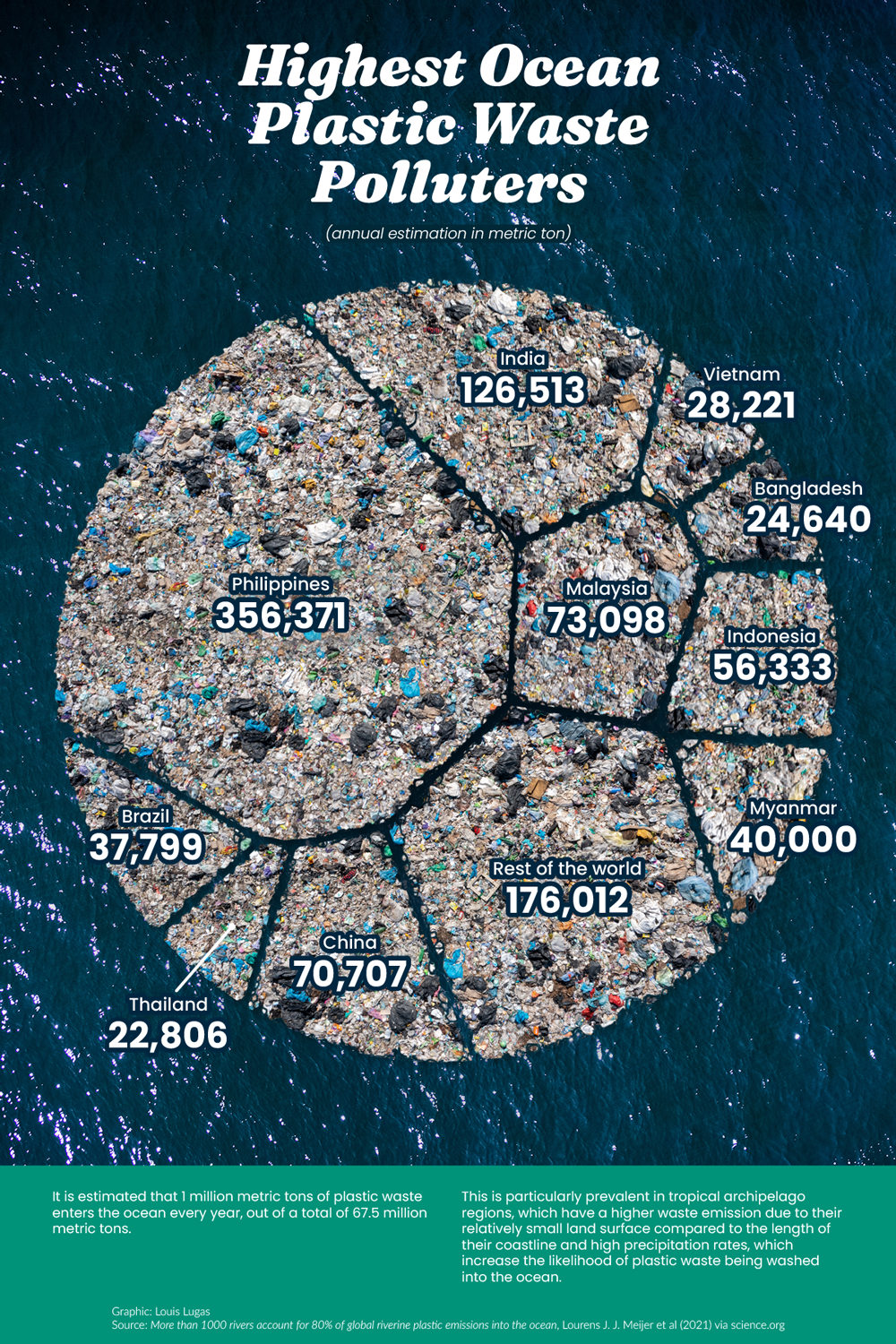
Visualized: Ocean Plastic Waste Pollution By Country

Millions of metric tons of plastic are produced worldwide every year. While half of this plastic waste is recycled, incinerated, or discarded into landfills, a significant portion of what remains eventually ends up in our oceans.

In fact, many pieces of ocean plastic waste have come together to create a vortex of plastic waste thrice the size of France in the Pacific Ocean between California and Hawaii.

Where does all of this plastic come from? In this graphic, Louis Lugas Wicaksono used data from a research paper by Lourens J.J. Meijer and team to highlight the top 10 countries emitting plastic pollutants in the waters surrounding them.

Plastic’s Ocean Voyage

First, let’s talk about how this plastic waste reaches the oceans in the first place.

Most of the plastic waste found in the deep blue waters comes from the litter in parks, beaches, or along the storm drains lining our streets. These bits of plastic waste are carried into our drains, streams, and rivers by wind and rainwater runoff.

The rivers then turn into plastic superhighways, transporting the plastic to the oceans.

A large additional chunk of ocean plastic comes from damaged fishing nets or ghost nets that are directly discarded into the high seas.

Countries Feeding the Plastic Problem

Some might think that the countries producing or consuming the most plastic are the ones that pollute the oceans the most. But that’s not true.

According to the study, countries with a smaller geographical area, longer coastlines, high rainfall, and poor waste management systems are more likely to wash plastics into the sea.

For example, China generates 10 times the plastic waste that Malaysia does. However, 9% of Malaysia’s total plastic waste is estimated to reach the ocean, in comparison to China’s 0.6%.

RankCountryAnnual Ocean Plastic Waste (Metric tons)
#1🇵🇭 Philippines356,371
#2🇮🇳 India126,513
#3🇲🇾 Malaysia 73,098
#4🇨🇳 China 70,707
#5🇮🇩 Indonesia56,333
#6🇲🇲 Myanmar40,000
#7🇧🇷 Brazil37,799
#8🇻🇳 Vietnam28,221
#9🇧🇩 Bangladesh 24,640
#10🇹🇭 Thailand22,806
🌐 Rest of the World176,012
Total1,012,500

The Philippines—an archipelago of over 7,000 islands, with a 36,289 kilometer coastline and 4,820 plastic emitting rivers—is estimated to emit 35% of the ocean’s plastic.

In addition to the Philippines, over 75% of the accumulated plastic in the ocean is reported to come from the mismanaged waste in Asian countries including India, Malaysia, China, Indonesia, Myanmar, Vietnam, Bangladesh, and Thailand.

The only non-Asian country to make it to this top 10 list, with 1,240 rivers including the Amazon, is Brazil.

The Path to a Plastic-free Ocean

The first, and most obvious, way to reduce plastic accumulation is to reduce the use of plastic. Lesser production equals lesser waste.

The second step is managing the plastic waste generated, and this is where the challenge lies.

Many high-income countries generate high amounts of plastic waste, but are either better at processing it or exporting it to other countries. Meanwhile, many of the middle-income and low-income countries that both demand plastics and receive bulk exports have yet to develop the infrastructure needed to process it.

https://cutt.ly/78GuaxQ

понедельник, 8 февраля 2016 г.

Year in review: BPA alternatives aren't benign

receipt handling
BAD TRADE  In trying to swap out the potentially toxic compound BPA in their products, manufacturers may be using chemicals that are just as bad, researchers found this year.

Replacements cause problems in lab animals

BY 


A popular alternative to bisphenol A isn’t as benign as people had thought, at least not in lab animals.

After a growing body of research identified hormone-mimicking effects from BPA — a compound found in some plastics, dental sealants and cash register receipts — consumers began reaching for BPA-free products. But there is now evidence that at least one of the chemical substitutes, bisphenol S, can enter the body and trigger developmental and physiological changes.

A study published this year found that BPS can boost heart rates and lead to heart-rate variability in rats. Another reported altered brain development and behavior in fish (SN: 4/4/15, p. 10).

The effects in humans are unclear, but store cashiers who handled receipt paper at work excreted more BPS in their urine after a shift. Researchers also detected the structurally similar compound BPSIP in the blood of cashiers who handled receipts with and without BPSIP and in the urine of some people who don’t work as cashiers, suggesting another widespread source (SN: 10/3/15, p. 12).

COMPOUND SWAP With consumers seeking BPA-free products, BPS and BPSIP are serving as alternatives. But scientists haven’t established the safety of these replacements.

суббота, 29 августа 2015 г.

The ‘Drinkable Book’ Can Literally Save Your Life

By Carl Engelking

The drinkable book's pages can be torn out and used as filters. (Credit: photo courtesy Brian Gartside/Drinkable Book)
The drinkable book’s pages can be torn out and used as filters. (Credit: Photo courtesy Brian Gartside/Drinkable Book)

Sure, a good book can forever change your perspective on life, but one book can literally save your life.
According to the World Health Organization, 3.4 million people die each year due to health issues stemming from unsanitary water. To combat this alarming trend, scientists are working to produce and distribute “drinkable books” to people living in third-world countries. But this isn’t your ordinary book: Each page can be torn out and used to turn sewage into drinkable water.
07_Drinkable_Book_Water_Pour
(Credit: Photo courtesy Brian Gartside/Drinkable Book)

Drink Up

The “drinkable book” in the brainchild of Theresa Dankovich, from Carnegie Mellon University in Pittsburgh, who was researching a simple, inexpensive way to sanitize water. She developed “pAge drinking paper,” which is a sturdy sheet of paper loaded with silver and copper nanoparticles that kill dangerous microbes living in dirty water. The nano-paper eliminates 99 percent of bacteria living in the dirtiest water, and the resulting water contains metal levels well below U.S. guidelines for safe drinking water.
Dankovich tested her filter papers on 25 different water sources in five countries with success. She unveiled the results of her project at theAmerican Chemical Society’s national meeting this week.

Dankovich has teamed up with the nonprofit organization WATERisLIFE to mass-produce books that are filled with this specialized paper. Each “drinkable book” contains information in English and the local language about water safety, as well as filtering instructions.
A single sheet of paper can purify up to 26 gallons of water, and a single book can supply a person’s water needs for up to four years.

Scaling Up

Now, the goal is to raise funds in order to scale up production of the books. Dankovich, to this point, has hand-produced each book in a church kitchen – it’s a long process. Dankovich has made about 50 books, which took over 60 hours for the paper treatment and drying process. WATERisLIFE is working on securing production funds to distribute the life-saving books around the world.
For the sake of clean water, we hope drinkable books become a global bestseller.