Показаны сообщения с ярлыком astrophysics. Показать все сообщения

воскресенье, 18 сентября 2022 г.

Why and how do planets rotate?


George Spagna, chair of the physics department at Randolph-Macon College, explains.

Stars and planets form in the collapse of huge clouds of interstellar gas and dust. The material in these clouds is in constant motion, and the clouds themselves are in motion, orbiting in the aggregate gravity of the galaxy. As a result of this movement, the cloud will most likely have some slight rotation as seen from a point near its center. This rotation can be described as angular momentum, a conserved measure of its motion that cannot change. Conservation of angular momentum explains why an ice skater spins more rapidly as she pulls her arms in. As her arms come closer to her axis of rotation, her speed increases and her angular momentum remains the same. Similarly, her rotation slows when she extends her arms at the conclusion of the spin.

As an interstellar cloud collapses, it fragments into smaller pieces, each collapsing independently and each carrying part of the original angular momentum. The rotating clouds flatten into protostellar disks, out of which individual stars and their planets form. By a mechanism not fully understood, but believed to be associated with the strong magnetic fields associated with a young star, most of the angular momentum is transferred into the remnant accretion disk. Planets form from material in this disk, through accretion of smaller particles.

In our solar system, the giant gas planets (Jupiter, Saturn, Uranus, and Neptune) spin more rapidly on their axes than the inner planets do and possess most of the system's angular momentum. The sun itself rotates slowly, only once a month. The planets all revolve around the sun in the same direction and in virtually the same plane. In addition, they all rotate in the same general direction, with the exceptions of Venus and Uranus. These differences are believed to stem from collisions that occurred late in the planets' formation. (A similar collision is believed to have led to the formation of our moon.)

https://bit.ly/3SecB13


пятница, 29 октября 2021 г.

Our Galaxy is Caught Up in a Giant Cosmic Cobweb!


If we could zoom waaaay out, we would see that galaxies and galaxy clusters make up large, fuzzy threads, like the strands of a giant cobweb. But we'll work our way out to that. First let's start at home and look at our planet's different cosmic communities.

Our home star system

Earth is one of eight planets — Mercury, Venus, Earth, Mars, Jupiter, Saturn, Uranus, and Neptune — that orbit the Sun. But our solar system is more than just planets; it also has a lot of smaller objects.


An asteroid belt circles the Sun between Mars and Jupiter. Beyond Neptune is a doughnut-shaped region of icy objects called the Kuiper Belt. This is where dwarf planets like Pluto and Makemake are found and is likely the source of short-period comets (like Haley’s comet), which orbit the Sun in less than 200 years.

Scientists think that even farther out lies the Oort Cloud, also a likely source of comets. This most distant region of our solar system is a giant spherical shell storing additional icy space debris the size of mountains, or larger! The outer edge of the Oort Cloud extends to about 1.5 light-years from the Sun — that’s the distance light travels in a year and a half (over 9 trillion miles).


Sometimes asteroids or comets get ejected from these regions and end up sharing an orbit with planets like Jupiter or even crossing Earth’s orbit. There are even interstellar objects that have entered the inner solar system from even farther than the Oort Cloud, perhaps coming all the way from another star!

Our home galaxy

Let's zoom out to look at the whole Milky Way galaxy, which contains more than 100 billion stars. Many are found in the galaxy’s disk — the pancake-shaped part of a spiral galaxy where the spiral arms lie. The brightest and most massive stars are found in the spiral arms, close to their birth places. Dimmer, less massive stars can be found sprinkled throughout the disk. Also found throughout the spiral arms are dense clouds of gas and dust called nebulae. The Sun lies in a small spiral arm called the Orion Spur.


The Milky Way’s disk is embedded in a spherical “halo” about 120,000 light-years across. The halo is dotted with globular clusters of old stars and filled with dark matter. Dark matter doesn’t emit enough light for us to directly detect it, but we know it’s there because without its mass our galaxy doesn’t have enough gravity to hold together!

Our galaxy also has several orbiting companion galaxies ranging from about 25,000 to 1.4 million light-years away. The best known of these are the Large and Small Magellanic Clouds, which are visible to the unaided eye from Earth’s Southern Hemisphere.

Our galactic neighborhood


The Milky Way and Andromeda, our nearest neighboring spiral galaxy, are just two members of a small group of galaxies called the Local Group. They and the other members of the group, 50 to 80 smaller galaxies, spread across about 10 million light-years.

The Local Group lies at the outskirts of an even larger structure. It is just one of at least 100 groups and clusters of galaxies that make up the Virgo Supercluster. This cluster of clusters spans about 110 million light-years!


Galaxies aren’t the only thing found in a galaxy cluster, though. We also find hot gas, as shown above in the bright X-ray light (in pink) that surrounds the galaxies (in optical light) of cluster Abell 1413, which is a picturesque member of a different supercluster. Plus, there is dark matter throughout the cluster that is only detectable through its gravitational interactions with other objects.

The Cosmic Web

The Virgo Supercluster is just one of many, many other groups of galaxies. But the universe’s structure is more than just galaxies, clusters, and the stuff contained within them.


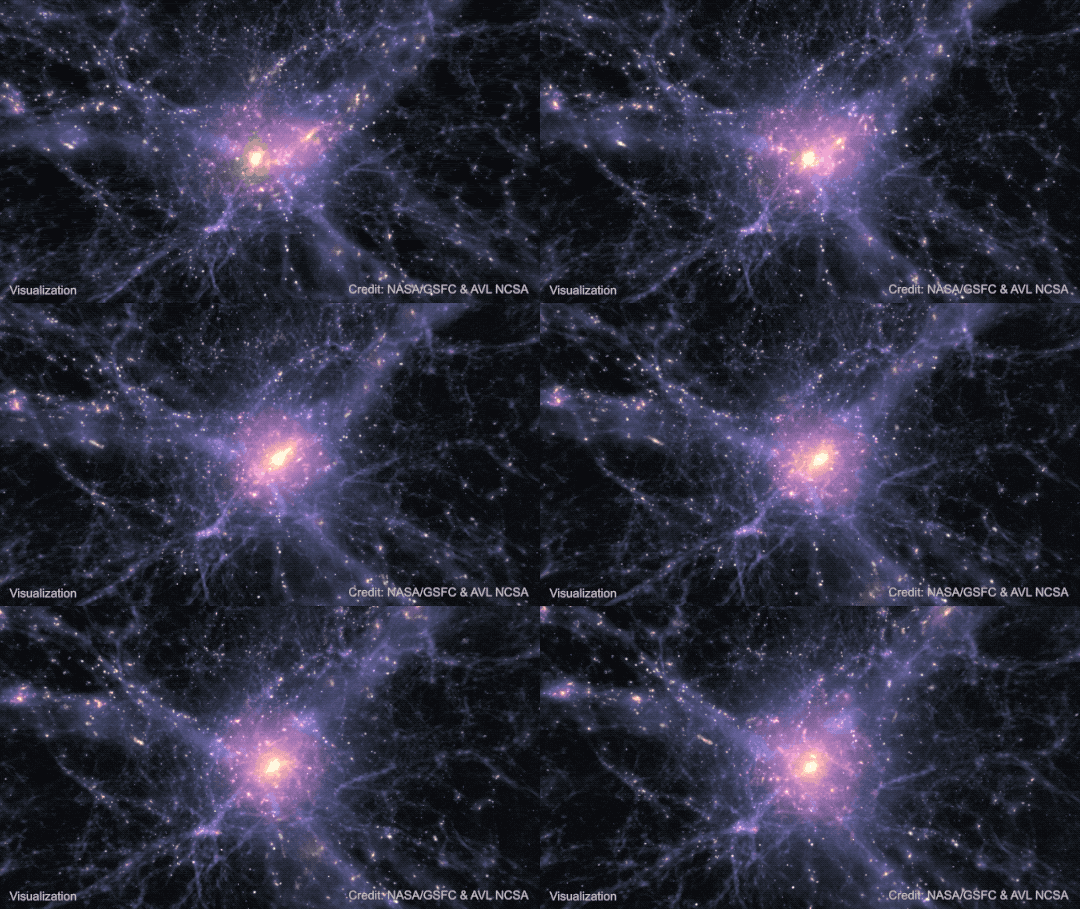
For more than two decades, astronomers have been mapping out the locations of galaxies, revealing a filamentary, web-like structure. This large-scale backbone of the cosmos consists of dark matter laced with gas. Galaxies and clusters form along this structure, and there are large voids in between.

The scientific visualizations of this “cosmic web” look a little like a spider web, but that would be one colossal spider!

And there you have the different communities that define Earth’s place in the universe. Our tiny planet is a small speck on a crumb of that giant cosmic web!

https://bit.ly/3nJtP8O

суббота, 16 апреля 2016 г.

The Water in Your Glass Might Be Older Than the Sun


The water you drink is older than the planet you’re standing on. CreditBiwa Studio/Getty Images

By 
Every Friday, we’ll offer a Trilobite talking point to help you bring a bit more science to your weekend conversations.
Earth is old. The sun is old. But do you know what may be even older than both? Water.
It’s a mystery how the world became awash in it. But one prevailing theory says that water originated on our planet from ice specks floating in a cosmic cloud before our sun was set ablaze, more than 4.6 billion years ago.
As much as half of all the water on Earth may have come from that interstellar gas according to astrophysicists’ calculations. That means the same liquid we drink and that fills the oceans may be millions of years older than the solar system itself.
The thinking goes that some of the ancient ice survived the solar system’s chaotic creation and came to Earth. To demonstrate that, researchers analyzed water molecules in oceans for indicators of their ancient past.
The clue comes in the form of something known as “heavy water.” Water, as you know, is made up of two hydrogen atoms and one oxygen atom. But some water molecules contain hydrogen’s chunky twin, deuterium. (It contains a neutron in its nucleus, whereas regular hydrogen does not.)

Photo
An illustration of how ancient water in the interstellar cloud drenched the solar system as the sun and planets formed. CreditBill Saxton, via, National Science Foundation, Associated Universities, Inc, National Radio Astronomy Observatory


Deuterium-rich water is found on other planets and moons, even here on Earth, but researchers are not sure where it came from. One idea is that much of the heavy water formed in the interstellar cloud and then traveled across the solar system.
Using a computer model, the scientists showed in a 2014 paper that the billions-of-years-old ice molecules could have survived the sun’s violent radiation blasts, and gone on to bathe a forming Earth and its cousins.
They concluded that remnants of that ancient ice remain scattered across the solar system: on the moon, in comets, at Mercury’s poles, in the remains of Mars’ melts, on Jupiter’s moon Europa — and even in your water bottle. Now that’s something to raise your glass to.

суббота, 13 февраля 2016 г.

The long road to detecting gravity waves

LIGO detector arm in Hanford, Wash.
LISTENING FOR GRAVITY WAVES  Two stainless steel tubes, 4 kilometers long, house laser beams and mirrors to detect waves from space at the Advanced Laser Interferometer Gravitational-Wave Observatory site in Hanford, Wash. Researchers with Advanced LIGO announced February 11 that they have directly observed gravitational waves.

News from Advanced LIGO means that Einstein’s theory can take us farther back than even he imagined


The January e-mail from Syracuse University physicist Peter Saulson caught me off guard. It probably shouldn’t have, since I had been anticipating the news for 16 years, ever since I wrote Einstein’s Unfinished Symphony. The book chronicled the astrophysical community’s most cutting-edge start-up: gravity wave astronomy.
Saulson’s message meant that Einstein’s symphony is no longer “unfinished.” A gravitational wave (gravity wave in common parlance), the historic prediction arising from Einstein’s equations of general relativity, had never been detected directly. But now, thanks to two colliding black holes, that unfinished task was finally completed, after decades of blood, sweat and immeasurable frustrations. It took that long to get a gravity wave detector working. More than that, the discovery’s announcement was made almost exactly 100 years after Einstein wrote his first paper on gravity waves. “As if those black holes were waiting for that moment,” Saulson says.
In papers published in the Proceedings of the Royal Prussian Academy of Sciences in 1916 and 1918, Einstein reasoned that just as electromagnetic radiation, such as radio waves, is generated when electric charges travel up and down an antenna, waves of gravitational radiation (what he called gravitationswellen) must also be produced when masses move about.
But these waves do not travel through space the way light does; they are literally quakes in spacetime’s very framework. Detectable rumbles emanate from the most violent events the universe has to offer — such as the ferocious encounter of two massive black holes (recorded by two gravity wave observatories) merging in a fateful embrace about 1.3 billion years ago. Alternately stretching and squeezing space, the wave right at the clash of the black holes would have stretched a 6-foot man to 12 feet and within a millisecond, squeezed him to 3 feet, before stretching him out once again.
Einstein never imagined such outrageous sources for his waves. Given the relatively quiet nature of the universe assumed in the 1910s, he was picturing waves rippling outward as two stars simply orbited one another. And he and others knew that those spacetime ripples would be feeble, certainly too weak to bother looking for them. Others wondered if his gravitationswellen didn’t exist at all and were rather just imaginary artifacts of the relativistic mathematics. General relativists argued back and forth over this issue for many years.

Hope and disappointment

But the stalemate shifted in the late 1950s, when a young University of Maryland physicist named Joseph Weber decided to build a gravity wave detector to settle the question. Experimental relativity was undergoing a renaissance at this time, and Weber had been encouraged by Princeton physicist John Archibald Wheeler, then the dean of American general relativity, to hunt for an actual wave.
Joseph Weber, in 1969, working on his gravity wave detector at the University of Maryland in College Park.
SPECIAL COLLECTIONS/UNIV. OF MARYLAND LIBRARIES
For his design, Weber surrounded a solid, water heater–sized cylinder of aluminum — a bar — with sensors, figuring that a passing wave would cause the bar to resonate like a bell. The sensors would convert the oscillations into electrical signals registered on a paper chart recorder. Two detectors separated by hundreds of miles, he reasoned, were needed to rule out local noises. In 1969, Weber grandly proclaimed at a relativity conference in Cincinnati that he had simultaneously recorded a signal on two bars, one situated on the Maryland campus, the other at Argonne National Laboratory near Chicago. Conferees greeted his announcement with applause (SN: 6/21/69, p. 593). The popular press heralded his find as the most important event in physics in half a century. “Many laymen will be startled, no doubt,” reported the New York Times. A year later, Weber declared that the signal was emanating from the center of the Milky Way galaxy, possibly from a supernova going off or maybe from pulsars, the rapidly spinning neutron stars that had been recently discovered.


Soon other physics groups built their own detectors. But they detected no waves whatsoever. Yet they didn’t give up. By the 1980s, teams in various countries had constructed even bigger bar detectors to increase sensitivity. They adjusted the designs, encasing detectors in supercooled fluids to reduce thermal noise. But, again, no signals were recorded. While Weber is still credited with jump-starting the field, the lack of verification damaged his reputation, although he insisted until his death in 2000 that his detectors were recording waves. Today, physicists put the claim down to noise and believe Weber didn’t fully understand the natural noises emanating within his bars.
But while the bar technology was maturing, a new gravity wave–detecting strategy surfaced — a method known as laser interferometry. Two researchers in the Soviet Union, Mikhail Gertsenshtein and V.I. Pustovoit, first published the idea in 1962, but no one outside their country became aware of it. Weber, too, briefly thought of the technique but never published. In 1966, Rainer Weiss at MIT also came up with the scheme independently — and in an offbeat way.

Bouncing lasers

Asked to teach a course on general relativity, Weiss, who worked on gravity as an experimentalist, not a theorist, scrambled. “I couldn’t admit that I didn’t know it. I was just one exercise ahead of my students,” he said in 1999. Arriving at the topic of gravity waves, and wanting to understand them from a more hands-on perspective, he came up with a homework assignment. Imagine, he told his students, three masses suspended above the ground, their orientation forming an L shape. How would the distances between those masses change as a gravity wave passed by? He knew that a gravity wave compresses space in one direction (say, north‑south), while expanding it in the other (east‑west). A millisecond later, as the wave passes by, the effect reverses. By the time Weiss worked out the solution for himself, he knew that he had a darn good experiment in mind. Continually bounce laser beams between the masses, have the beams eventually recombine (optically “interfere” with one another) to measure the gravity wave shifts, and you have a detector! And it had one great advantage over the bars. Whereas bars could be tuned to only one frequency, laser interferometers could register a wider range of frequencies, increasing the chances of detecting a source.
By 1972, Weiss had written a landmark report for MIT’s Research Laboratory of Electronics identifying all the fundamental sources of noise that could mask a signal in such a setup. The paper is still consulted today by gravity wave researchers. From that point on, Weiss devoted a large part of his career to getting a laser interferometer constructed and to finding the means to reduce those noises. There was extra incentive to do so: In 1974 radio astronomers Joseph Taylor and Russell Hulse, then at the University of Massachusetts Amherst, found a neutron star orbiting a dense companion, the two drawing closer and closer by about a few meters each year — just the change in distance physicists expect if the binary pair is losing orbital energy as gravity waves. Though the proof was indirect (and the waves themselves too weak to measure), it greatly encouraged the gravity wave astronomy community that sources would be available.
By the 1980s, Weiss joined forces with Caltech theorist Kip Thorne, the world’s top expert on the physics of gravity waves, and Scottish experimentalist Ronald Drever, also at Caltech, to leapfrog the small, laboratory prototypes being built and erect two sizable detectors with lengthy arms instead. A nearly simultaneous reception at a pair of detectors set far apart geographically would verify a wave passed through at the speed of light. Increasing the laser light’s path in the arms would magnify the detector’s sensitivity. Astrophysical sources, such as supernovas exploding or black holes colliding, generate ripples in spacetime that would be deadly near the event, but by the time those waves reach Earth, they would wiggle the interferometer masses less than the width of a proton. Kilometers-long arms would be needed to measure such subtle movements.
A feasibility study for this daring proposal (later dubbed the Laser Interferometer Gravitational-Wave Observatory) was completed in 1983. The report ultimately convinced the National Science Foundation (in particular NSF administrators Marcel Bardon and Richard Isaacson) to take a chance on going big. But so high was LIGO’s estimated construction cost (it rose to nearly $300 million) that it was the first time that the NSF had to go to Congress to get approval for a project. When astronomers and physicists heard about the proposal, a few became very vocal, angered that the NSF was proposing to use precious funds on a gamble rather than a proven technology. As a result, the LIGO proposal went through innumerable ups and downs and was almost canceled more than once (SN: 6/26/93, p. 408; SN: 1/8/00, p. 26).
A crucial turning point occurred in 1992 when Caltech physicist Rochus Vogt, then the LIGO director, wrangled a meeting with Louisiana Sen. J. Bennett Johnston, who later became an ardent supporter of the project. Vogt originally had only 20 minutes, but his tales of cosmology so captivated Johnston that the senator canceled his next three appointments. For several hours, the two huddled over the senator’s coffee table, while Vogt drew pictures of curved spacetime. Once again, Einstein’s name worked magic. Congress eventually authorized funds to build two detectors, each with 4-kilometer-long arms. One was situated in Livingston, La., the other 1,900 miles to the northwest in Hanford, Wash.
Ground was broken for those first-generation detectors in 1994. Both were up and running by 2001. Primarily a test bed to try out the novel technologies needed to find a gravity wave, the first LIGO wasn’t expected to register any waves. But it still did its job. What LIGO collaborators learned from each detector’s performance went into the design of innovative instrumentation, which was gradually installed over the last five years. This upgrade, called Advanced LIGO, led to an increased sensitivity that, bingo, found a gravity wave as soon as it began operation last fall.
Instruments around the globe are already joining LIGO’s quest. A LIGO-like detector known as VIRGO, run by a European collaboration, has been operating on the vast alluvial plain outside Pisa, Italy, since 2007. (VIRGO was offline for instrumentation improvements when Advanced LIGO registered its first gravity wave.) A smaller interferometer named GEO600, with 600-meter-long arms, operates in Germany. Other detectors are under construction in Japan and planned for India.
But laser interferometers on Earth are limited in the frequencies they can register (roughly 10 to several thousand hertz), much the way an optical telescope cannot see radio waves or X-rays. To expand that range so gravity wave events from a variety of sources can be detected, gravity wave astronomers are pursuing other methods as well. One clever scheme is based on well-studied astronomical objects — pulsars, the most exquisite timepieces in the universe due to the unvarying rhythm of beeps emitted by the rapidly spinning neutron stars (SN: 10/17/15, p. 24). By closely monitoring the pulses arriving from an array of particularly fast pulsars situated around the sky, astronomers are on the lookout for slight changes in the pulsing due to an extremely low-frequency gravity wave (10-9to 10-6 hertz) passing between the pulsar and the earthbound detector. Supermassive black hole binaries would emit these tremendously long waves as they slowly orbit in the centers of merging galaxies. And ultimately, researchers hope to send laser interferometers into space. The European Space Agency is working on a proposal called the Evolved Laser Interferometer Space Antenna (SN Online: 12/3/15), which would enable the detection of weaker gravity waves.

A new astronomy

What the world is witnessing is the birth of a new astronomy. Detecting the ripples of those two black holes, uniting in the distant universe, is like Galileo’s first peek at the heavens through a telescope in 1609. Galileo discovered moons orbiting Jupiter and jagged mountains and craters on the moon, amazing wonders to 17th century eyes. Now, gravity wave astronomy is poised to offer its own radically new visions.
Electromagnetic waves, be they visible light, radio, infrared or X-rays, are released by individual atoms and electrons. Such radiation reveals a celestial object’s physical condition — how hot it is, how old it is, what it looks like and what it is made of. Gravity waves convey much different information. They will tell about the overall motions of massive objects, indicating how they move, twirl and collide throughout the universe, especially for objects that are too small to be seen directly, such as neutron stars and stellar black holes.
“We’ve now embarked on an era of exploring phenomena in the universe that are made from warped spacetime,” Thorne says. “I like to call it the warped side of the universe.” In due course, this new method of observing may be able to record the remnant rumble of the first nano­second of creation, by gathering the residual gravity waves emitted by the awesome spacetime jolt of the Big Bang itself.
After more than four long and turbulent decades, Weiss has at last seen his experimental dream come true. Did he ever despair? “No,” he says without hesitation today. “The reason you don’t worry about the end result is this: The problems were interesting, you enjoyed the people you were working with, and it was fun to do!” Ever the experimentalist, Weiss, now 83, continues to travel to observatories, roll up his sleeves and check out the equipment.
He worked on the initial idea in the 1970s with just a few colleagues and students; today, more than 1,000 people are involved — LIGO/VIRGO collaborators at universities and institutes around the world advancing both the theory and the technology.
At the dedication of LIGO’s Louisiana observatory in 1999, Rita Colwell, then director of the NSF, noted that those gathered were “breaking a bottle of champagne over the figurative bow of a modern-day galleon — a gravity wave observatory that may ultimately take us farther back in time than we’ve ever been.” With their first signal, a crescendo that when converted to audio starts as a deep bass and heads toward middle C, LIGO scientists are beginning their journey, now able to listen for the myriad events that await detection.
With that in mind, I take back what I said at the opening to this essay. Einstein’s symphony will never be finished. 


среда, 20 января 2016 г.

Beyond the Outer Limits

planck-anamolies
Planck’s map of the early universe shows asymmetry between hemispheres and a striking cold spot. 
ESA and the Planck Collaboration

Maps of radiation left over from the Big Bang may show traces of universes besides our own.


For Laura Mersini-Houghton, it’s been a surprisingly short journey from Tirana, Albania, to the edge of the universe.
Step one came 20 years ago, when she moved to the United States as a Fulbright scholar, studying physics at the University of Maryland. Step two came a decade later, when she began exploring novel ways to merge quantum theory and cosmology. Step three arrived in May 2009 with the launch of the European Space Agency’s Planck satellite, which soon began making detailed maps of the Big Bang’s leftover radiation.
And step four? That’s happening right now. Mersini-Houghton has developed an expansive theory that explains not only how our universe began, but also where: among a far grander universe of universes, the multiverse. Her concept sounds like science fiction, but she insists she was merely being logical. 
“I was trying to understand the question of the origin of our universe, and I realized that the only way to address the question is by allowing a multitude of possible universes,” she says in a brisk voice. 
She’s not the first scientist to take this kind of head trip. More than 50 years ago, Hugh Everett postulated an endless series of parallel universes as part of his “many worlds” interpretation of quantum physics. Recent versions of string theory, which attempts to knit together all of physics into a single set of equations, predict 10500 different realities, each with its own physical laws. But Mersini-Houghton brings something unique: evidence.
“The power in this theory is that you have a whole series of predictions that are all starting to be observed,” she says. In the latest Planck satellite data, Mersini-Houghton sees nothing less than the outlines of other universes projected onto the sky.
A Lopsided Universe
You can see those spectral universes, too, once you know what to look for, if you do as Mersini-Houghton did. Check out Planck’s full-sky map and focus on anything that’s out of balance.
The Planck map shows microwave radiation emitted shortly after the birth of the cosmos. It is covered with spots and blobs, indicating places where the infant universe was either denser or less dense than average. The dense spots are what gave rise to structure in the universe, from superclusters of galaxies down to stars and planets. (In case you’re wondering, the relatively sparse areas evolved into enormous voids with few galaxies.) So far, so good. If there were no structure in the early universe, we wouldn’t be here. 
Trouble starts when you pull back and take in the big picture. Scientists have long believed that the universe as a whole must be the same in all directions. The laws of physics are symmetric, after all, so the universe should be as well. Einstein even enshrined that idea as the “cosmological principle.” But the Planck maps are notnice and uniform — not even close.
Look closely, and you’ll notice two major signs that something’s off-kilter. First, the northern half of the sky looks substantially lumpier than the southern half. Second, the southern part of the sky sports a large “cold spot” where the cosmic microwaves are less energetic than average. If you run statistics on the Planck data (don’t worry, someone already did this for you), you’ll discover a third oddity: The universe is distinctly less lumpy on large scales than it should be, according to standard cosmology models. 
I asked George Efstathiou, a veteran astrophysicist at the University of Cambridge and a key member of the Planck science team, what he makes of these anomalies. “You’d have to admit that the universe looks a bit odd,” he agrees. “The question is, how odd? My own assessment is that it’s odd at the 1/20 level.” That means there’s a 1 in 20 chance that we are simply seeing the effects of random variations. 
Flip it around, and there’s a 19 in 20 chance that there is some funny business going on. 
Cosmic Belly Buttons
The reason the universe looks odd to us, Mersini-Houghton thinks, is that cosmologists have been starting from a faulty assumption: that our universe is the one and only. “Whenever we get something that doesn’t make sense, we have oversimplified the system,” she says. “If you consider the possibility of other universes, you can still have a universe that is uniform, but then there is something else creating anomalies.”
She traces those anomalies back to a fraction of a fraction of a second after the Big Bang, when our universe was so small that it behaved like a subatomic particle, dominated by quantum physics. Such particles can get intertwined, or “entangled,” so that their physical properties remain linked even if they move huge distances apart. 
Mersini-Houghton theorizes that our entire universe became entangled with others during its formative moments. The features in the Planck map are the lingering result. “If I look in one direction in the sky, I see a wave that corresponds to a particular type of universe,” she says. “If I look at another direction, I see a different wave with a different energy.”
Take away the esoteric physics language, and Mersini-Houghton’s theory boils down to a simple, startling idea: The oddities in the Planck maps are like cosmic belly buttons that trace an ancient umbilical connection between our universe and other universes that have grown up and gone their separate ways. 
With such an extraordinary claim, I call on Efstathiou, a no-nonsense seasoned observer, for a reality check. “It’s a novel idea; very speculative physics but completely plausible,” he says brightly. “The question is, what can we do? Is there an observational way of testing the multiverse?”
Efstathiou is busily answering his own question, sifting through the rest of Planck’s enormous data archive. By the end of the year, he and the rest of the Planck team will release an improved, far more complete description of the north-south asymmetry, the cold spot, the missing large-scale structure and other currently inexplicable deviations in the cosmic microwave background. “Then maybe these hints of something will turn into a compelling case. That would certainly make my day,” he says. 
Out of Many, One
No matter what the Planck team finds, Mersini-Houghton is convinced that other universes must exist. Maybe her particular theory is not correct; maybe the other universes aren’t detectable for now. But on the deepest theoretical and philosophical level, she thinks that the traditional concept of a single, lonely universe makes no sense. 
Current cosmology models indicate that our universe was born with an extremely high initial energy, Mersini-Houghton notes; otherwise it would have fizzled out as soon as it began. That specificity gnawed at her, especially after she heard physicist Roger Penrose calculate that the odds of it happening by chance were an absurd 1 in 10127. “I wondered, ‘Why should we have had such a special start?’ That’s been a big problem in physics.” 
The multiple-universe theory is her solution. She pictures a vast landscape, far grander than the visible universe, in which the natural fluctuations of quantum physics drive endless random energy variations. Any one of those fluctuations can spawn a universe, but the weak ones go nowhere; they appear and die away without a trace. Only the rare, high-energy fluctuations produce viable Big Bangs and keep going. Successful universes like ours would inevitably come to dominate. That problem of specificity vanishes.
Mersini-Houghton places this new conception of the universe in the context of the discovery that Earth is one of many planets, the sun one of many stars, the Milky Way one of many galaxies. For her, the multiverse is the next step away from the primitive idea of cosmic uniqueness and toward grander enlightenment. Who knows where the next steps might lead?